

Introduction
For most of the time I have worked in fintech, innovation moved in one direction, from the US and Europe outward. The job of a team in Montevideo, São Paulo or Bogotá was to take something that had already matured somewhere else and adapt it to local conditions.
Online banking was fitted to local rails. Credit scoring was rebuilt around whatever the local bureaus had. Brokerages showed up, and someone worked out how to onboard people who had never held a bank account. Emerging markets were, for a long time, the second market by definition, and what reached them was a translation of a product designed for somewhere else.
That still happens, and a good part of the work we do at Vangwe is exactly that kind of adaptation. But over the last few years something different has been showing up in our projects, often enough that it has changed how we scope, estimate, and build.
New ideas are arriving in emerging markets first, or being born there outright, and they are not adaptations of anything, because in a growing number of categories the mature-market version was never the starting point at all. This is what fintech leapfrogging looks like from inside a delivery team.

Credit and identity: lending and KYC without a bureau file
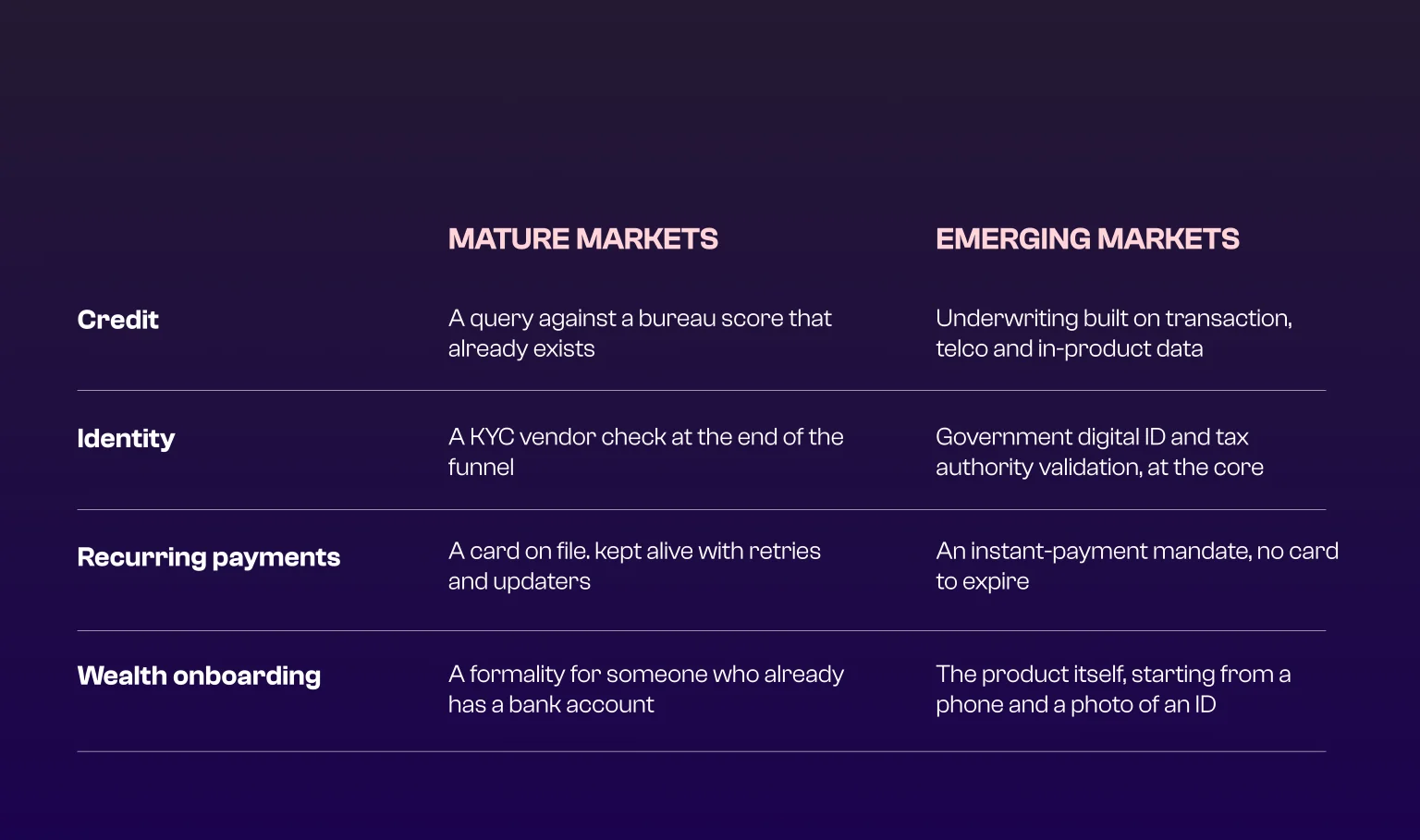
Consumer credit is a clear example. In mature markets like the US, lending sits on top of decades of bureau data, held by companies such as Experian, Equifax and TransUnion, and a credit product is fundamentally a query against a score that already exists. The applicant arrives with a number attached, and the lender's job is to decide what to do with it.
In most of Latin America and much of Southeast Asia that score does not exist for the majority of the people you would want to lend to. Large parts of the population are unbanked or underbanked: paid in cash, no card, no mortgage, no formal loan, nothing that leaves a trace in a bureau. That is the absence of a score rather than a bad one, and a system built to rank borrowers cannot rank people it has never seen.
So lenders that work in these markets built underwriting on transaction data, telco data, and the applicant's behavior inside the product itself. Tala lends in Kenya, Mexico and the Philippines off smartphone and transaction data. In Kenya, M-Shwari and Fuliza lend against M-Pesa history rather than a bureau file. Nubank grew in Brazil by approving customers the bureaus could not score at all.
The direction has since reversed. FICO and Experian both launched scores built on cash-flow data in 2025, aimed at exactly the thin-file customers (people with little or no bureau history) the bureau model was never able to reach.
Identity went the same way. Where a US or European fintech can lean on a mature KYC vendor and a national identity that is more or less assumed, a fintech in Brazil, Mexico, or India builds directly against government digital identity systems (India's Aadhaar, Brazil's CPF, Mexico's CURP and SAT), biometric checks, and tax authority validation. The onboarding flow is the core of the product rather than a compliance step at the end of the funnel, because whether a person can be onboarded at all is the business question.
On a commerce platform we build in Mexico, merchant onboarding runs against SAT validation, so tax authority data decides activation rather than a form. That identity flow took more design effort than the feature the company was actually selling, and it was the right place to spend it.
Money and wealth: instant payments, stablecoin settlement and mobile-first brokerage
Money movement shows the pattern most sharply. The mature-market answer to cross-border flows is correspondent banking, with settlement measured in days. And the mature-market answer to recurring payments is a card on file with a whole apparatus of retries and updaters to keep that card alive.
In emerging markets, an instant-payment mandate, such as a standing authorization to debit a bank account directly, such as Pix Automático in Brazil or UPI AutoPay in India, increasingly replaces the card for subscriptions, and a stablecoin rail with a local on and off ramp at each end increasingly replaces the correspondent bank. The reason is practical. The local banking layer was slow or expensive enough that a different rail won on merit.
On a US-Brazil payments platform we build, the retry logic a card-based product spends months on was never written, because collection runs on Pix Automático. The time went to reconciliation instead, where money landing in seconds at any hour breaks what a treasury layer assumes from cards. A ported design budgets for the first problem and meets the second in month four.

Picture by: Bruno Peres / Agência Brasil
Wealth followed a similar path. The reference brokerage, the product everyone still designs against, was built for a US customer who already had a bank relationship and a tax ID on file, and it lived on a desktop.
In Latin America the starting assumption is a phone, a photo of an ID and no prior financial footprint, so onboarding is the product and the trading screen is secondary. On a robo-advisor we build on IBKR and on an investment platform on the Alpaca Broker API, the same constraint set the shape of the product: getting someone with no brokerage history invested at all. Automating the portfolio is a solved problem. Opening the account is where both were won.
The same inversion applies to the interface itself, because in parts of Latin America the primary channel for a consumer financial product can be a chat thread on WhatsApp rather than an app, and the design questions that raises, what a session is, how identity persists, where state lives, have no equivalent in the app-first playbook.
What looks like version three from a mature market was version one here. The intermediate steps never happened, so there is nothing to adapt and no earlier version to fall back on.
Why copying the mature-market design fails when you expand
The consequence for anyone building in emerging markets is uncomfortable but useful: if you port the design of a mature market, you solve a problem nobody here has, and you skip the problem everyone has. We see this most often with companies expanding into the region with a working product and a proven architecture, whose reasonable instinct is to localize the payment methods and the language and launch.
What actually happens is that the local patterns reshape the flow rather than sitting inside it. A mandate-based subscription fails differently from a card. A stablecoin settlement changes when money counts as received. An identity flow built on a national system cannot reuse a funnel built around a vendor check.
There is a second consequence that matters more in the long run. If the newest patterns are appearing in emerging markets first, then teams building only for mature markets are working from an incomplete map. The things that look like regional quirks today (alternative-data underwriting, instant-payment mandates, stablecoin settlement, conversational interfaces) are early versions of things that will show up everywhere. The teams that have already shipped them in production are the ones who know where the sharp edges are.

Three questions before the estimate
What changed for us is mostly a matter of order, and it is the part clients push back on most, because it makes the first two weeks slower and the first number later.
Three questions set the architecture, and all three sit underneath the integration work: who settles locally. What the regulator requires at onboarding. How money is allowed to move between the parties in the flow. Connecting to a broker API or a stablecoin provider costs roughly the same effort anywhere. The layer underneath decides whether the flow you already have survives the move.
Emerging markets did not catch up to mature-market fintech. In a growing number of categories they went around it. If you are building for these markets, the question worth asking is what this market already does that the rest have not reached yet, rather than how to adapt what works elsewhere. That is usually where the product is.