All Post
When should you hire a fintech software development company?


One question comes up in almost every conversation I have with fintech founders, payment companies, and businesses building payment products :
When does it actually make sense to bring in a fintech software partner instead of building everything in house?
The answer isn't always "now."
Sometimes hiring externally is unnecessary. But I've also seen companies spend six months recruiting before writing a single line of code, while others shipped faster because they knew where bringing in specialists would actually make a difference.
Payments are different from most software. Building payment software requires much more than writing code. You're not just building features. You're moving money, which involves payment gateway integrations, banking infrastructure, navigating compliance, fraud prevention, security, and building highly reliable financial systems to ensure everything works exactly as expected when real customers depend on it.
In payments, the cost of getting it wrong is simply higher. That's why many companies choose to work with a fintech software development company instead of building every capability internally.
After working with fintechs, payment companies, and merchants over the past few years, I've noticed the same situations come up again and again.
What does building in house really cost?
Before deciding whether to hire a fintech software development company or build an in-house engineering team, it's worth considering the alternatives.
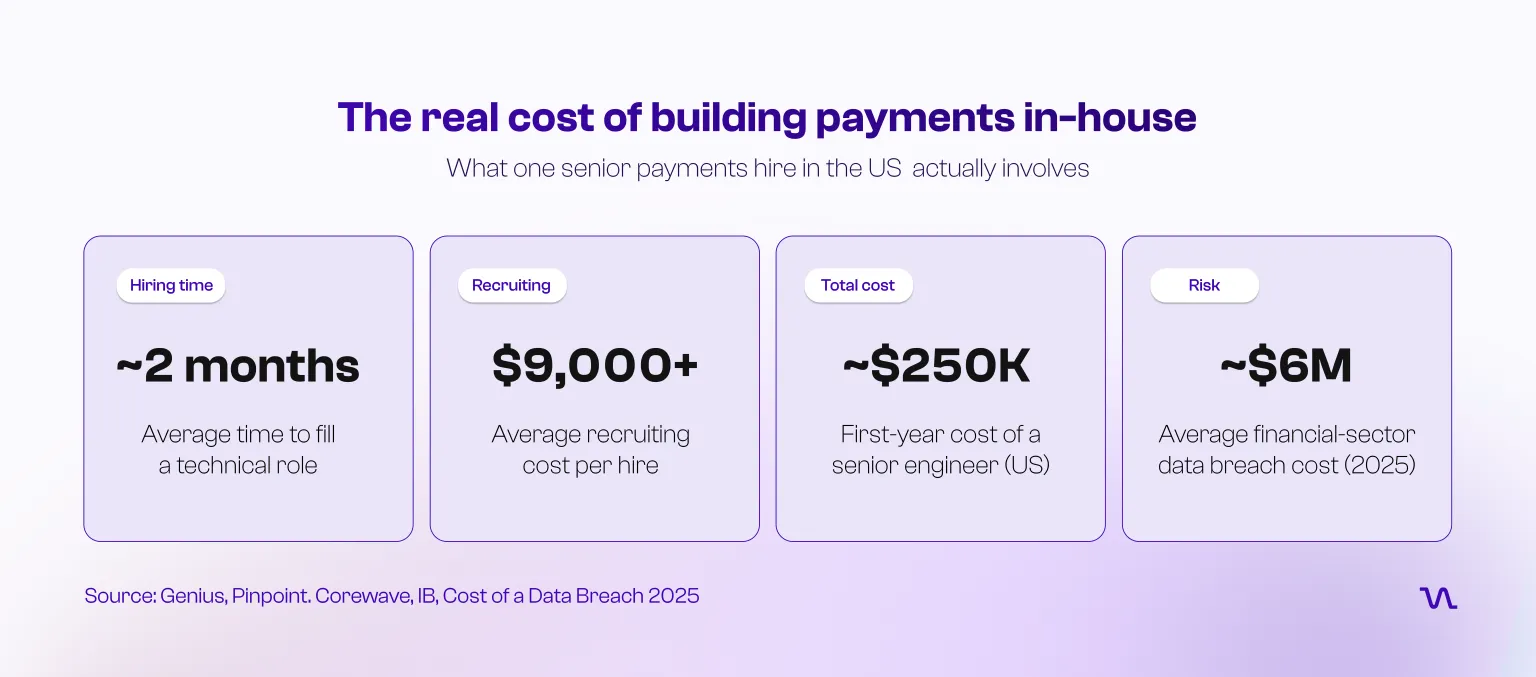
Building an engineering team in the US is harder and more expensive than expected. Filling a technical role takes about two months on average, and specialized engineering roles are among the slowest to fill. Recruiting alone can cost over $9,000 per hire, and with a US salary, benefits, onboarding, and equipment, the first year cost of a senior engineer can approach $250,000. On payments: the average data breach in the financial sector cost nearly $6 million in 2025, now cited to IBM's primary Cost of a Data Breach report rather than an aggregator.
So... when does it actually make sense?
I've found there are several situations where bringing in a specialized fintech software development partner creates the most value. They're very different types and stages of companies. Still, they all have one thing in common: payments have become critical to the business, and building everything internally would slow them down.
In our experience as a fintech software development company building payment products for fintechs, payment companies, and merchants, these are the situations where hiring external fintech engineers delivers the highest return.
1. You're building a fintech product from scratch
This is probably the scenario I see most often today, and it's changed a lot over the last year.
More founders are using AI and vibe coding to turn an idea into a working prototype. Honestly, I think that's a good thing. It lets you validate an idea, show investors something tangible, and figure out whether customers actually want what you're building without spending months writing code.
The challenge comes later. A prototype that works in a demo isn't the same as a product that's ready for production. That's especially true in fintech, where you're handling money, integrating with financial institutions, and building systems that need to be secure, compliant, reliable and capable of handling real payment transactions at scale.
That's where the gap between "it works" and "it's ready" becomes obvious.
A specialized fintech software development team doesn't just write more code. They help turn an early prototype into something that can actually support real customers. That means designing the right architecture, choosing the right payment providers, thinking through compliance from the beginning, and handling the edge cases that AI or a first version usually won't catch.
In other words, vibe coding can get you surprisingly far. But getting to production still requires experience. In fintech, that gap hasn't disappeared because of AI. If anything, it's become even more important.
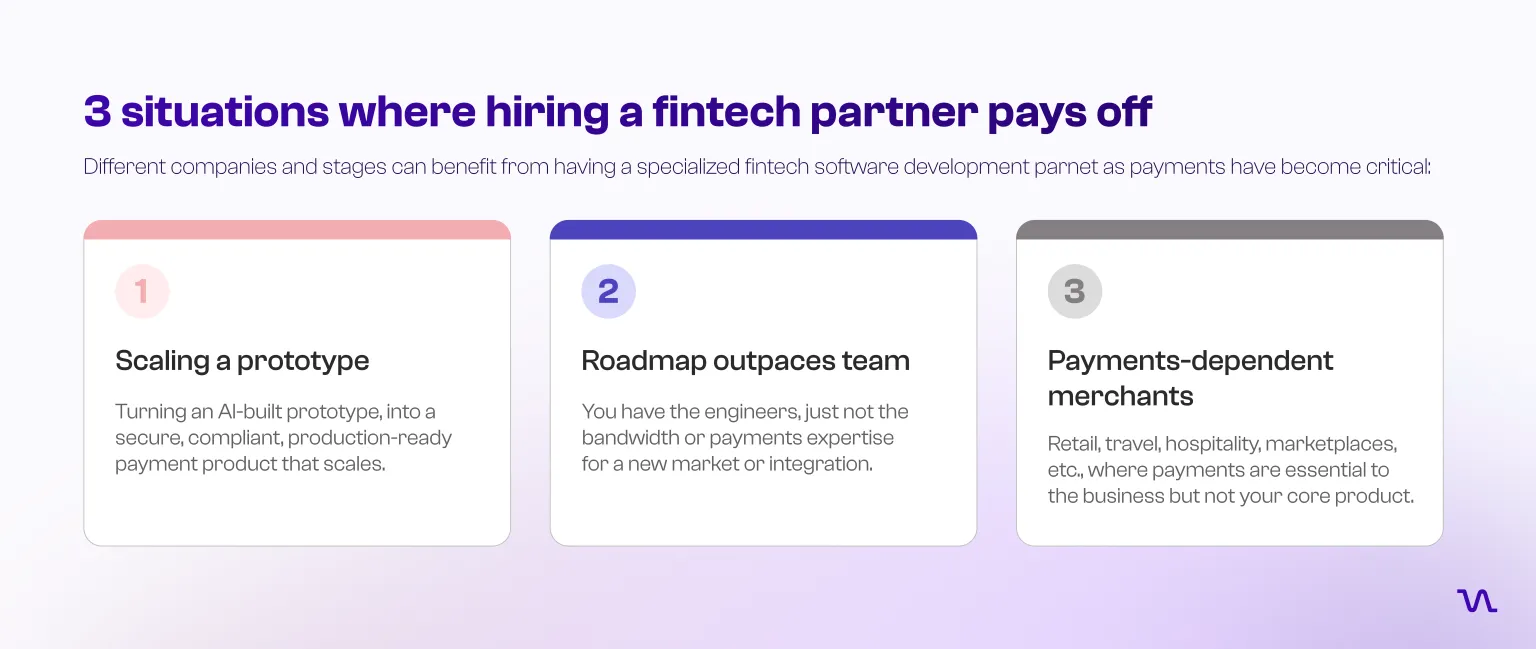
2. Your roadmap is growing faster than your team
The companies in this scenario already have an engineering team. Their problem isn't capability; it's bandwidth.
Maybe they're launching in a new country. Maybe they're integrating Stripe, Adyen, Airwallex, Checkout.com, local payment methods, or another payment service provider. Maybe they've raised a new round but want to stay lean instead of doubling headcount. Or maybe they simply need payments expertise that their internal team hasn't had a reason to develop.
Hiring permanent employees for a six-month project rarely makes sense. An embedded fintech team gives companies the flexibility to scale up when they need it and scale back when they don't, while keeping ownership of the product and roadmap in house.
You're not replacing your engineers. You're giving them people who've solved similar problems before.
3. Merchants where payments are critical, but not your core business
The third group looks very different.
They're hospitality platforms, retailers, marketplaces, travel companies, SaaS businesses... companies where payments are essential to the customer experience but not the product they're known for.
These businesses know their customers better than anyone. What they usually don't have is a team that lives and breathes payment infrastructure.
As they grow, payments become more than just a checkout page. They start thinking about expanding internationally, adding local payment methods, improving authorization rates, reducing fraud, or staying compliant across different markets.
That's when payments stop being "just another feature" and become a competitive advantage.

So what are companies actually looking for?
One thing I've noticed over the last few years is that buyers have become much more selective.
Price still matters, of course. But it's rarely the deciding factor.
The companies that make the best long-term decisions usually prioritize fintech experience, security, compliance, scalable architecture, integration expertise, and a partner who will still be there after launch.
That makes sense. Rebuilding a payment system is almost always more expensive than building it properly the first time.
"Can't AI just build it?"
I get this question frequently. The short answer is yes... and no.
AI is already making software teams dramatically more productive. We use it every day ourselves. But payments aren't difficult because writing code is difficult. They're difficult because the business logic is.
AI can generate code quickly, but building payment software still requires human expertise in payment flows, banking integrations, PCI compliance, reconciliation, fraud prevention, and financial system architecture. Ask an AI model to build a checkout flow and it'll probably generate something that looks great in a demo. The real challenge is everything around it.
What happens if a customer refreshes the page halfway through a payment? What happens when a provider sends the same webhook three times? What information should never be logged? How does settlement work in one country versus another?
Those aren't coding questions. They're payment questions. The best teams today aren't choosing between AI and experienced engineers. They're combining both.
You don't have to go all in
Another misconception is that bringing in a specialist means committing to a massive project.
In reality, most companies start much smaller.
Sometimes it's a two-week payments audit to identify risks and define a roadmap. Sometimes it's payment gateway integration support. Sometimes it's one senior engineer joining an existing team. Sometimes it's a fixed-scope integration or an embedded squad for a product launch.
The goal isn't to outsource everything, it's to bring in specialized experience exactly where it creates the most value.

Final thoughts
There's no universal answer to whether you should hire a fintech software development company.
But I've found one question usually makes the decision much easier:
Is payments becoming a critical part of your business, even if it's not your core expertise?
If the answer is yes, it probably doesn't make sense for your team to learn everything through trial and error.
The companies that move fastest aren't always the ones with the biggest engineering teams. More often, they're the ones that know which problems they should solve themselves and which ones are worth handing to people who've already solved them many times before.
That's ultimately where a specialized fintech software development partner makes the biggest difference.