All Post
Ignoring Compliance in Fintech: Risks Every Founder Must Know


Building a fintech product is exciting: innovative payment flows, investment solutions, and the potential to change how people manage money. But one common mistake that can cost you time, money, and credibility is ignoring compliance and regulatory requirements from the start.
Not only can lack of compliance lead to huge fines and remedial work, it can destroy growth momentum, compromise user trust, undermine product product-market fit and even lead to market shutdowns.
This guide isn't about listing regulations. Instead, it's a practical roadmap for creating secure, scalable fintech products while minimizing regulatory risk. We'll cover real-world examples from successful clients and cautionary tales from the industry, so you know what to anticipate when building your fintech product.
Why compliance matters in Fintech Product Development
Compliance isn't just legal red tape, especially in fintech. It's a core part of fintech product development and risk management. Skipping it until after launch usually leads to:
Regulatory fines and penalties
Forced product redesigns
Delayed product launches and market entry
Reputational damage
Blocked partnerships with banks or processors
Below, you'll see how even major unicorn fintechs have learned this the hard way, and why integrating compliance early and continuously is non‑negotiable.
High‑profile Fintech Compliance Failures (and what they teach us)
Monzo: £21M Fine for AML Control Failures
Between 2018–2022, the UK's Digital Bank Monzo onboarded more than 34,000 high‑risk customers without sufficient anti‑money‑laundering controls, even after being warned by the regulator. Their address verification system was disabled, allowing implausible data (e.g., Buckingham Palace addresses) to pass through. Ultimately, regulators fined them £21 million for inadequate AML controls.
Takeaway: Scaling without proportional investment in compliance infrastructure invites regulatory action and costly remediation, even for well‑funded fintechs.
Revolut: €3.5M AML Penalty for Transaction Monitoring Gaps
In 2025, Revolut's European operations were fined €3.5 million by the Bank of Lithuania after routine inspections uncovered deficiencies in monitoring transactions and relationships, meaning some suspicious activity went undetected.
Takeaway: Rapid growth and multi‑jurisdictional expansion increase AML risk; transaction monitoring systems must scale with operations.

Block / Cash App: Multi‑Million AML Settlement
Block Inc., the parent company of Cash App, agreed to a $40 million settlement with the New York DFS over AML program failures including unreviewed alert backlogs and insufficient due diligence on risky transactions.
Takeaway: Even large fintech brands are liable if compliance pipelines don't keep pace with transaction volumes and risk profiles.
Coinbase Europe: €21.5M AML Fine Due to Technical Gap
In 2025, Coinbase's European arm was fined €21.5 million after a coding/monitoring logic error allowed millions of transactions to bypass AML checks entirely.
Takeaway: Compliance failures don't always stem from intent, operational or technical gaps in monitoring logic are just as serious.
Common Compliance Risk Areas that sink Fintech Products
These are the root causes behind most fines, audits, and remediations:
Insufficient KYC/AML Onboarding and Monitoring
Failing to verify identities (or monitor transactions over time) creates gaps that regulators treat as direct threats to financial crime prevention.Inadequate Risk‑Based Controls
Static systems that don't adapt to changing user behavior or geographic risk factors will miss suspicious activity and trigger enforcement later.Poor Scaling of Compliance Processes
As user volumes increase, alert backlogs and manual reviews can paralyze operations and be flagged by regulators as systemic weaknesses.Technical Blind Spots in Monitoring Engines
Errors in detection logic or exclusion of edge cases can let high‑risk activity slip through, as seen in the Coinbase case.Regulator‑Specific Requirements (NACHA, 3DS, PSD2)
Missing local payment regulation integration (like NACHA rules in the US) results in fines and onerous retrofitting.
Compliance Risk Map for your Product Roadmap
Here's a framework you can apply to reduce regulatory risk before it slows down your product:
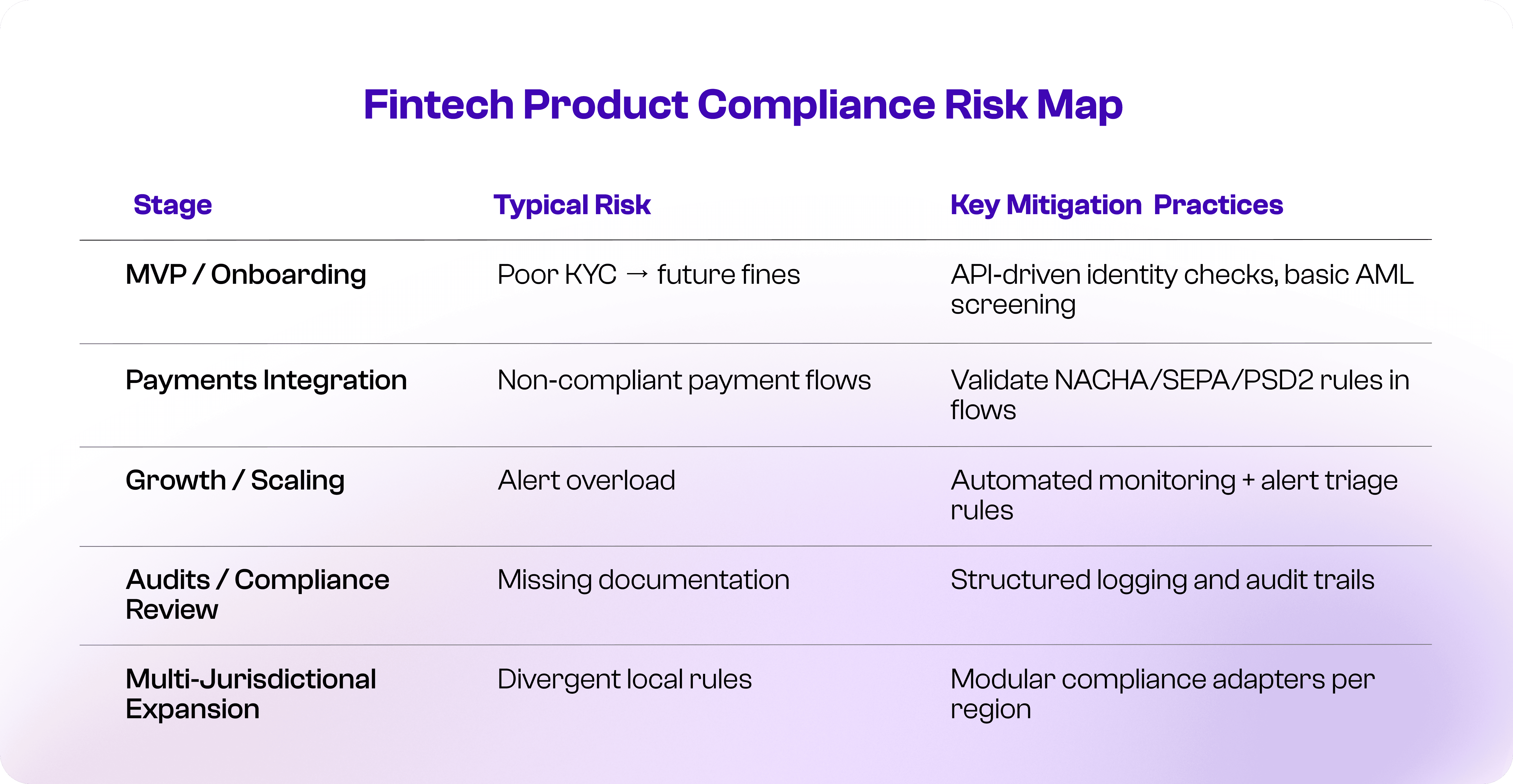
Checklist: Compliance Questions product teams must ask early
Before building your fintech product, answer these:
✔ Do you have KYC/identity verification built into onboarding?
✔ Can your transaction monitoring system scale with volume?
✔ Are alerts triaged automatically to prevent backlog?
✔ Can your logging and reporting support future audits?
✔ Have you aligned payment flows (ACH/NACHA/3DS/SEPA, etc.) to regulatory rules?
✔ Do you have a risk‑based approach for high‑risk user segments?
Real success cases: How Compliance worked as a product enabler
Failure isn't the whole story, compliance can also fuel growth when done right.
Guesty: Bank‑Compliant Files & NACHA Integration
Enabling vendors and owners to get paid might sound straightforward, but for property management companies, it's a complex puzzle of identity verification, regulatory requirements and operational steps. We tackled this challenge with Guesty by building a Payouts platform integrated with Airwallex.
The platform handles embedded KYC/KYB flows, RFI (Request for Information) handling, micro-deposit verification, and ACH-based funding, ensuring every transaction meets the identity verification and anti‑money laundering standards that regulated payment providers require.
The outcome is a compliant, end-to-end disbursement system built on Airwallex's infrastructure, with full webhook handling, beneficiary management, and batch transfer capabilities, turning a traditionally complex and high‑risk process into a secure, traceable, and reliable workflow for property managers.

Bamboo: 3D Secure Integration to reduce chargebacks
Instead of waiting until launch to bolt on payment authentication, Bamboo integrated 3D Secure (3DS) with Cybersource Payer Authentication early in the product flow. This proactive approach reduced fraud and chargebacks from day one, expanded compatibility across payment methods, and future‑proofed the platform for advanced 3DS-as-a-Service use cases, turning a common post‑launch headache into a seamless, secure experience for users.

Conclusion: Compliance doesn't slow you, it protects you
Ignoring compliance now might seem like a quick path to market, but the examples above show that regulatory risk becomes far more expensive later: fines, forced rewrites, delayed launches, reputational harm, and fractured banking partnerships.
When compliance is embedded into product design from the start, with clear controls, monitoring, and risk management, it becomes a strategic asset, not a burden.
Want to see how compliant fintech products are built in practice? Explore our success stories at Vangwe to see how we help teams integrate compliance from Day One.
