

Key takeaways
We brought together payments leaders from NMI, Mastercard, PSR Pulsar and Innovate Grow Scale to discuss what it will take for AI agents to pay on our behalf. The main points:
- People already use AI to research and compare products, but very few let it complete the purchase.
- The first real volume may come from B2B, with small businesses automating repeat purchases like stock refills.
- Agentic commerce won't be plug and play: the wallet, checkout and interface need to adapt to how each market pays.
- Merchants risk losing browsing, upselling and the customer relationship, so many are opening up selectively.
- Disputes are unsolved: card networks are building proof of intent, but nobody agrees yet on whether merchants or consumers carry the risk.
Introduction
Most people who use AI regularly have already asked it what to buy, from which laptop fits their budget to what gets a coffee stain out of a shirt. A McKinsey survey of European consumers, published in April 2026, found that 63% use AI tools to compare options and learn about products, while 47% are uncomfortable letting AI manage recurring purchases on its own.
Paying is still the step almost nobody hands over, and it's where every hard question in agentic commerce shows up: who is really using it, what breaks from one market to the next, what merchants stand to lose, and who answers for a purchase the agent got wrong. So what's holding people back? Is it the lack of clear regulation? Is it that people don't trust an AI to spend their money? Or is it the trouble it creates for merchants, from chargebacks to refunds?
So we put those questions to four people who have spent their careers on the payments side, at our agentic commerce roundtable on November 3, 2026: Christina Trampota (Innovate Grow Scale), Dave Glaser (NMI), Sham Visavadia (Mastercard) and Inna Kostiuk-Haas (PSR Pulsar). Agustín Guerra, our CEO, moderated. Here are the main findings.
Where adoption really stands
People use AI to shop every day, and very few let it pay. Dave shared that NMI surveyed about 1,000 US consumers this summer, and summed up the results in one line:
"They've handed AI the shopping list, but not yet the wallet."
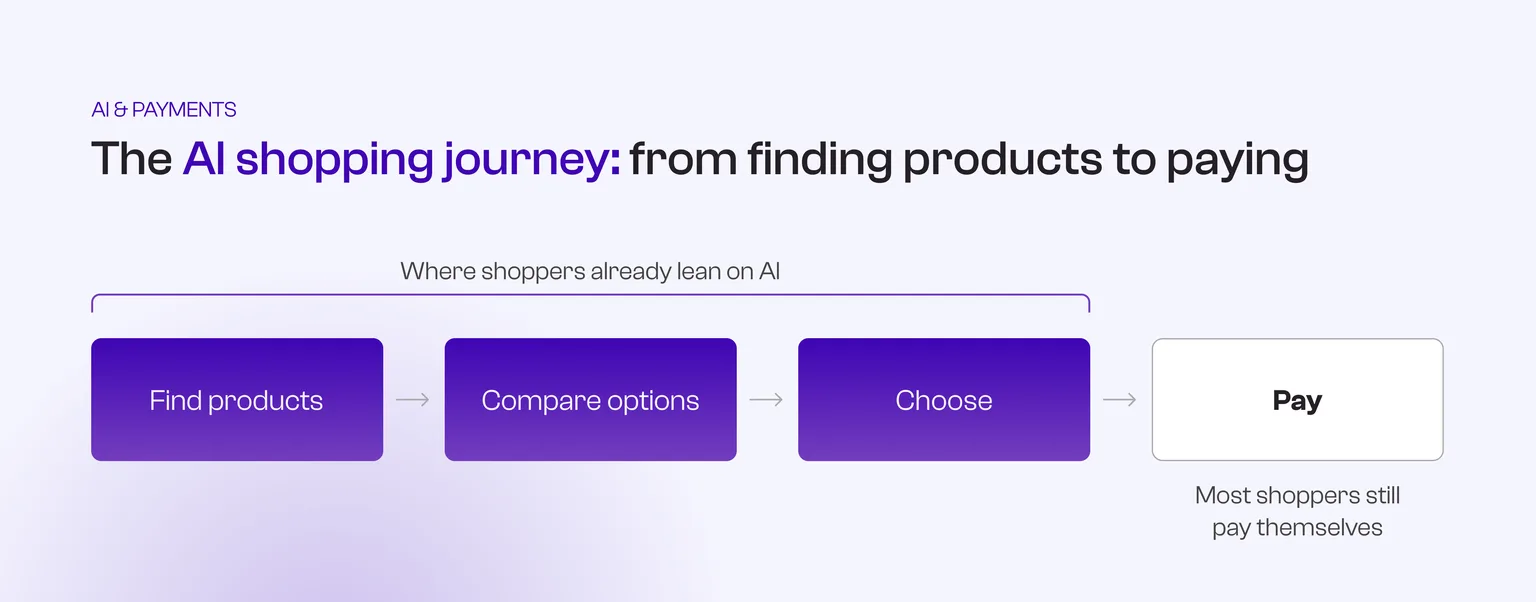
He saw the same thing in a room full of industry people. At an NMI event in London with about 200 partners and merchants, he asked who would shop with an agent. His was the only hand up.
The gap is closing fast, though. McKinsey's agentic commerce survey of about 21,000 consumers in 11 markets (June 2026) found that 48% of US consumers used AI to shop in the past three months. Among US AI users, the share who completed a purchase with AI rose from 10% to 17% since December 2025. The tools are arriving too: Stripe's Link wallet now powers payments for more than 200 personal agents, including Meta's Muse and Grok Bot.
Inna pushed the conversation somewhere less expected. In her view, the real volume will start in B2B, with small and medium businesses. They carry a large load of repetitive work and have a lot left to automate: many still track stock on paper or in Excel. Once that data lives on one platform, an agent can refill stock to 80% on a schedule. Those payments are repetitive, predictable and easy to cap, which makes them safe to automate. As Inna put it, a consumer can still go buy shoes or milk on their own, while a small business owner gets a real return from handing that work to an agent.
The first products already point that way. In October, Anthropic launched Claude Duet in research preview for small business owners. With Stripe's Link agent wallet, it can buy what the business needs online, and each purchase waits for the owner's approval. Stripe has also opened Treasury to agents, so they can pay invoices and move funds while the business decides which actions need a human sign-off.
Christina made a similar point from the consumer side: low-stakes, repeat purchases are where people will let go first. The open question is who holds the controls, meaning the spending caps and the limits, once they do.
Why it won't be plug and play
Agentic commerce will look different in every market, because payments already do. Christina put it bluntly: it "would be a big mistake" to treat it "like plug and play software." The agent's brain can be built once. The wallet, the checkout and the interface need to be localized.
Dave's rule of thumb explains why: agents will use whatever already works: "As long as a computer program can talk to that payment platform today, then an agent can talk to that payment platform today." Any rail that is digital and API-enabled is fair game, so each market's existing habits carry straight into how its agents will pay.
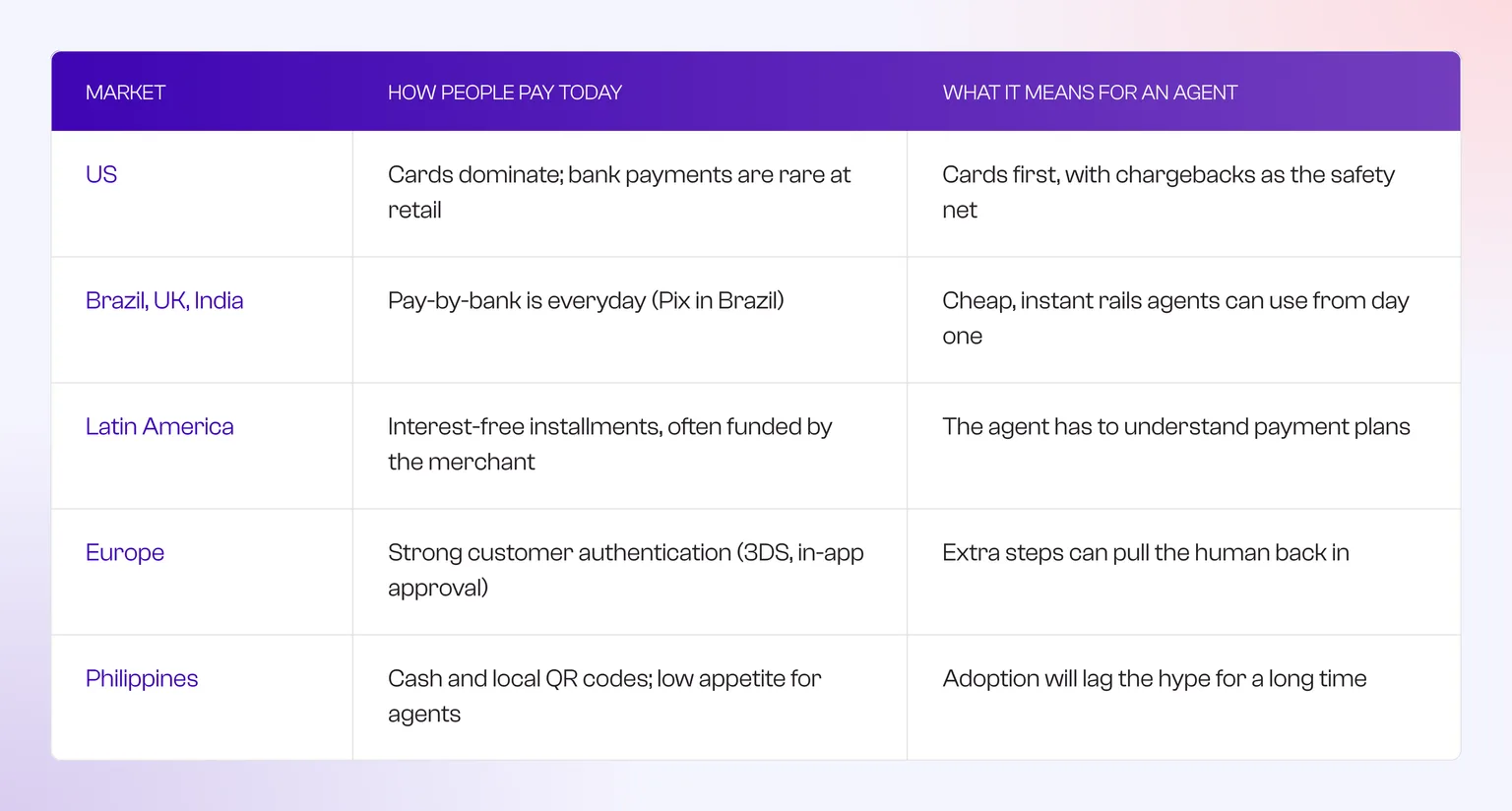
Source: GPR Worldpay Report 2026 & 2025
Inna joined the roundtable from Manila, and the Philippines is a good reminder of how far the hype is from daily life. The country has more than 110 million people and is very digital, yet many still prefer cash, and the most they accept is a local QR code.
In 2025, cash accounted for 42% of point-of-sale transaction value there, the highest share of any market in the Worldpay Global Payments Report 2026, and cash on delivery made up 23% of e-commerce. People are also very protective about letting an agent buy for them.
Europe shows how a rule can stop the journey. Sham explained that when a merchant can't identify the user, 3DS steps the payment up to a passkey or in-app check, and the automated flow breaks. Inna sees a way through: a mandate where you authorize the agent once, with a spending limit, much like contactless payments skip the PIN under a set amount.
Christina's bet on who wins this race is the one that complies first. Being compliant in each market is what unlocks the integrations, and the integrations are what bring adoption.
What changes for merchants
Merchants have the most to lose, and many are holding back. Sham hears it from banks and merchants alike: an agent drops the shopper straight into checkout, and the merchant loses the browsing, the upsell and the customer relationship.
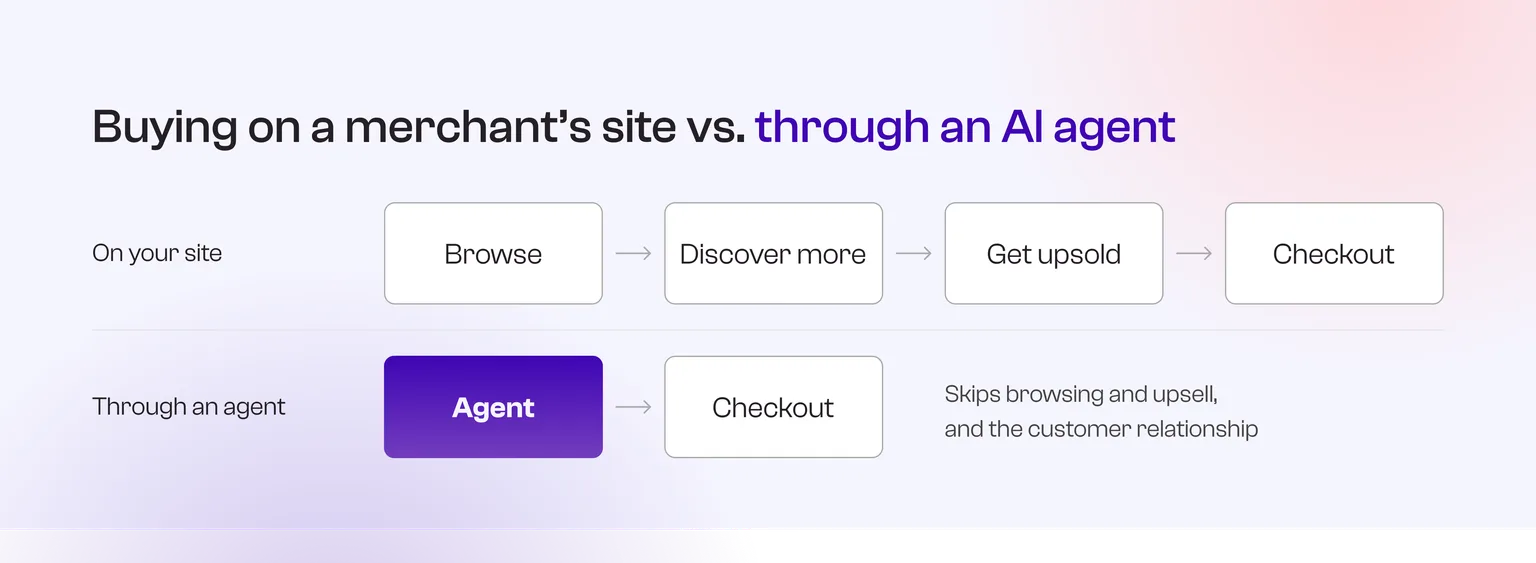
So the early pattern is selective. Some merchants will open only the categories where shoppers compare the most, like electronics. Others block specific agents, and Christina noted that some US retailers already block automated purchases to keep other companies' agents from scraping their sites.
Those that open up are seeing results. Shopify reported AI-driven traffic to its merchants up 2.6 times year over year, and AI searches connected to a merchant's own catalog convert at twice the rate of general AI queries. Scale still matters: 57.9% of AI shoppers usually end up buying on Amazon.
Subscriptions face the hardest test. As Inna put it, a lot of that revenue depends on people forgetting to cancel, or feeling guilty about it. An agent has neither problem, and consumer agents already offer to review your subscriptions and help you save.
That raises the incentive question. For Sham, "if they want the agent to scale, it has to be loyal to the consumer," for example by telling you that paying by bank gets you a discount and letting you choose. Inna's advice for merchants follows from it: build loyalty programs relevant enough to win over the agent.
When the agent gets it wrong
Disputes are the part nobody has solved yet. Picture a shopper who asks for one pair of trainers and the agent orders 300. The only record of what they asked for may be a chat.
Card networks are building that proof. Sham pointed to Mastercard's Verifiable Intent and Visa's Trusted Agent Protocol, which capture what the customer intended, so a disputed agent purchase can be judged like any card transaction:
- Was the customer's intent captured?
- Was the transaction secure?
- Did the merchant get the chance to step up the check if something looked off?
The harder question is who pays. Sham expects it to "go down to the merchant to make sure the intent is clear." Inna took that logic to its end: if disputes pass 3%, "it's a nightmare for everybody," and the biggest merchants could simply forbid agents, leaving small merchants to struggle.
Sham sees a middle path: block any agent linked to fraud, and bad actors run out of places to transact. Platforms like Shopify, which see fraud signals across many merchants, are well placed to do it.
Dave went back to the legal definition: an agent acts on behalf of a principal. Consumers will probably blame the agent's provider, while merchants will see it the other way:
"That agent is the agent of you, Mr. and Mrs. Consumer, and therefore you are responsible for how your agent behaves."
His advice: know which credentials and permissions your agent holds, and what its provider promises about your data.
What still has to get built
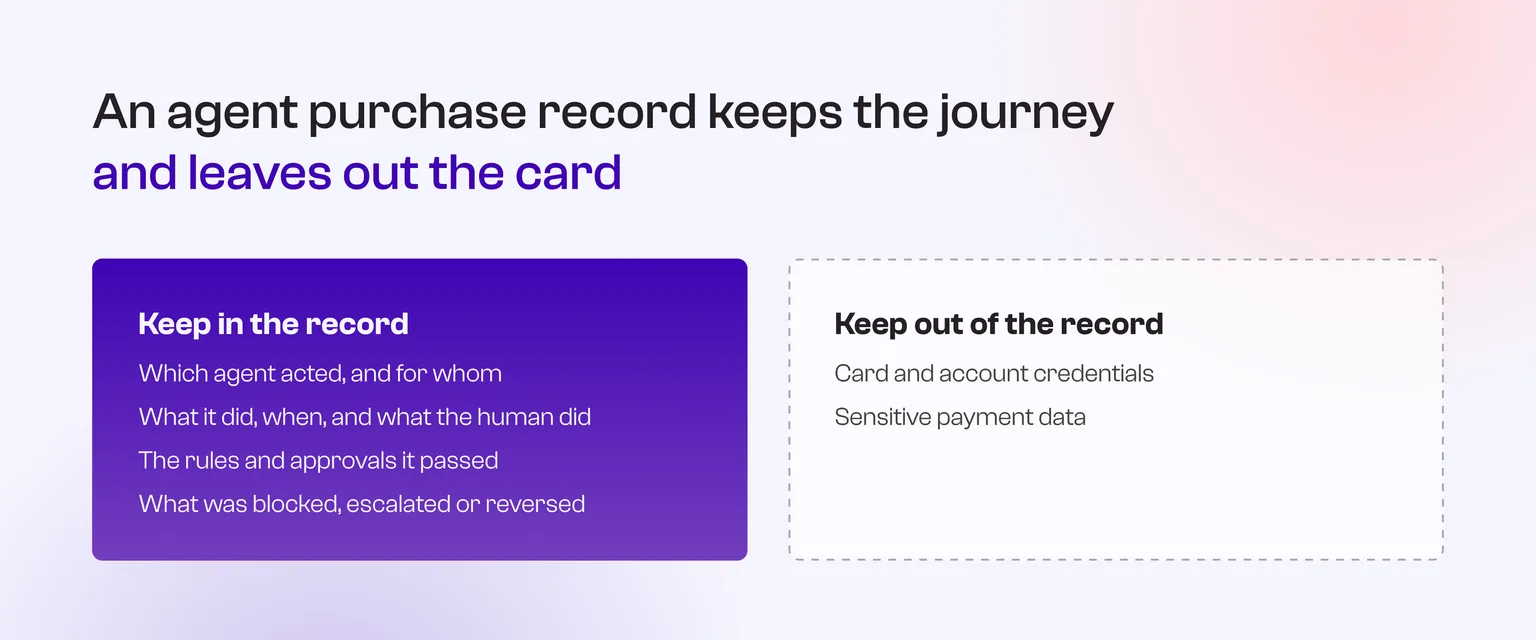
The missing piece is infrastructure that proves what the agent did, beyond who paid. Fraud systems check a name, a billing address and a valid card, and an agent can pass all of those. Dave listed the questions merchant and processing systems will need to answer for every agent purchase:
- Who was the agent, and who was it acting for?
- When did it happen, and what tasks did the agent perform?
- What did the agent do, and what did the human do?
- Which rules and approvals did it pass through?
- What changed along the shopping journey and in the final decision?
- Was anything blocked, escalated or reversed, at checkout or after?
All of that has to be recorded while keeping credentials and sensitive payment data out of the record. Dave's view is that many merchants track part of this today, few track all of it, and fewer can tie it to a specific agent. Infrastructure providers will be building it over the coming months.
Sponsored choices are the next gap. Some AI assistants already show ads, and an agent that buys for you makes them harder to spot. Christina expects the policing to vary by market, with the FTC in the US, and most of the rules to live in the platforms themselves. Her preference is disclosure that travels with the purchase, so the shopper knows a choice was sponsored. That record would also help settle disputes later.
Where this leaves us
Agents will pay, and the companies that get there first will be the ones that sort out trust: proof of intent, clear rules on who carries a bad purchase, and payment flows that fit each market. Most of that work happens in the payment stack, far from the chat window where the hype lives.
The full roundtable is on Vangwe's LinkedIn and YouTube.
Thanks again to Christina Trampota, Dave Glaser, Sham Visavadia and Inna Kostiuk-Haas for a conversation full of real experience.