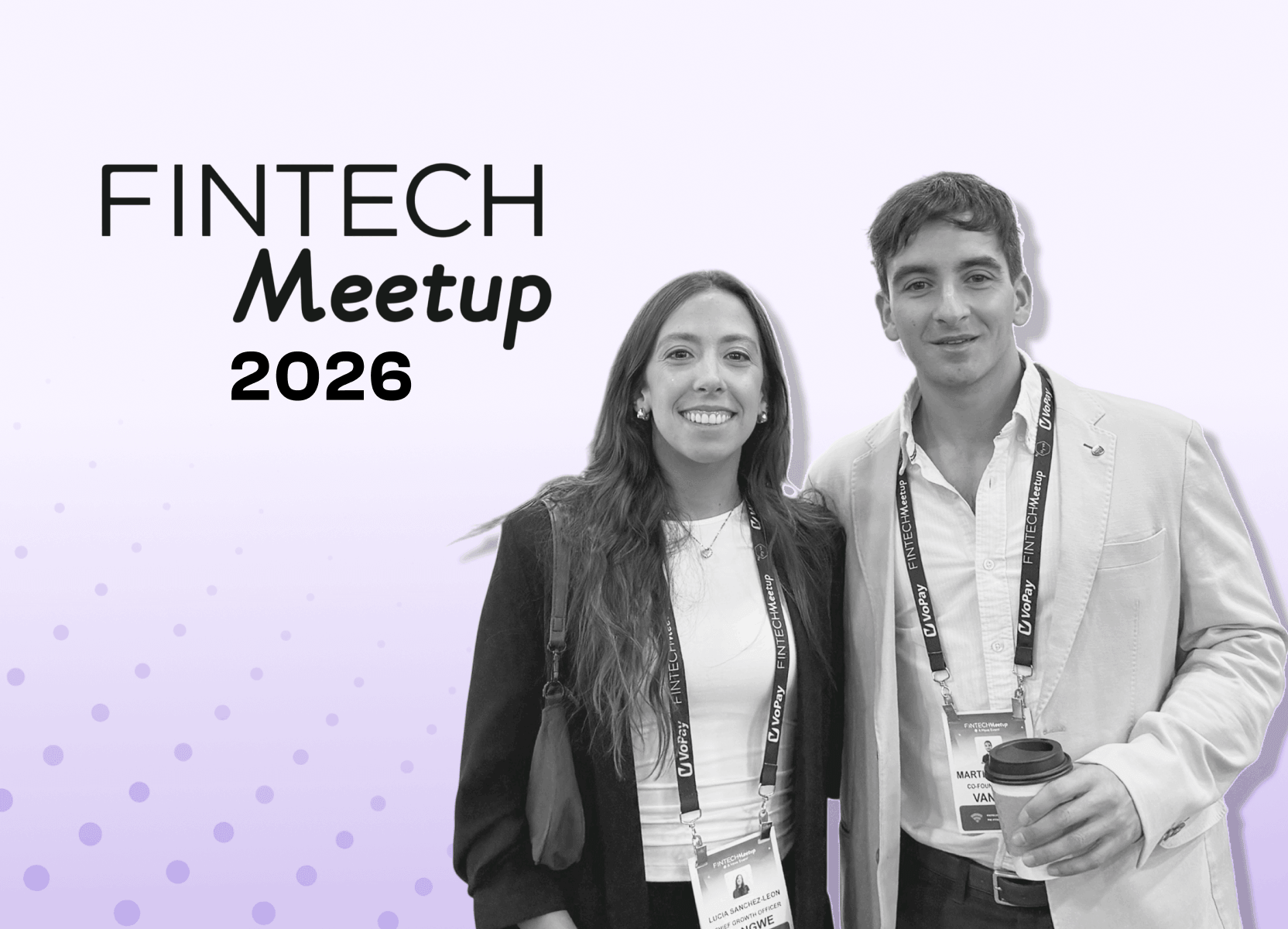

This year we made it to Las Vegas again for Fintech Meetup 2026, and I'll be honest, nothing quite prepares you for the energy of thousands of fintech, banking, credit union and payments people in one room, all moving fast and talking even faster.
Between all the conversations, interviews, 1:1 meetings and keynotes throughout the week, a few things kept coming up and stuck with me. So here are some of the ideas that stuck with me after the event:
1. Agentic commerce: the topic that took over many conversations
If I had to pick one phrase I heard more than any other at Fintech Meetup 2026, it would be agentic commerce. We're talking about AI systems that don't just assist, they act. They compare, decide, transact and manage financial interactions on your behalf, without needing you to approve every step.
Banks and credit unions are already experimenting with this, and the gap between companies that have embedded AI across their entire teams, not just in engineering, versus those that haven't is becoming very visible, very fast.
But the most grounding thing I heard all week? The question isn't whether it can be built. Anyone can build. The real question is whether customers actually want it. That one stuck with me.
2. Stablecoins are no longer a niche conversation
There were more stablecoin companies and startups at this event than I've ever seen together in one place. And it makes sense: with clearer regulatory frameworks now in place in the US, the category has gone from speculative to fundable almost overnight.
What clicked for me was the connection to agentic AI: if you're building systems that execute thousands of micro-transactions autonomously, you need rails that are real-time, programmable, and transparent. Stablecoins offer exactly that. The infrastructure conversation in crypto has made a huge leap in the past year. This is no longer about speculation, it's about plumbing.
3. Consumer finance is still a mess, and the opportunity is enormous
One of the most honest conversations of the event was also one of the simplest: Americans are drowning in financial fragmentation. Too many accounts. Rewards scattered everywhere. Even the most financially savvy people can't get a clear picture of their own finances.
The natural next step: a single high-fidelity wallet that consolidates everything without putting you through KYC three more times, is obvious. It's just hard. But the analogy that landed best for me came out of a talk from Bolt's Ryan Breslow: one-click checkout was once fragmented too. But now they unified it. So, whoever does that for consumer finance earns the trust, builds the simplicity and owns the relationship.
The challenge is connectivity. And trust.

4. Why is the US still using checks?
I'll be real, this one surprised me. The conversation about checks came up more than once, and not as a joke. The US is still deeply reliant on paper-based payments in ways that almost no other developed economy is, and while there's genuine appetite to change it, changing embedded habits is slow.
What's interesting is that the problem isn't technical, the technology to do better already exists. It's cultural and structural. Meanwhile, in markets like certain parts of Asia have moved to highly unified payment experiences, and Europe has Revolut, a trusted, non-social-network-linked financial brand that scaled across an entire continent.
In the US, social networks tried to crack payments and failed. The consensus at the event was pretty clear: America is heading toward a European model, where a small number of deeply trusted brands own the commerce and finance experience, and they won't be social media companies.
5. AI has made fintech faster, just not easier
AI has absolutely accelerated the pace of development in fintech. Engineers are faster. Products iterate quicker. Data-enriched models are meaningfully smarter. But the hard parts, identity verification, compliance, integrations, are still hard. AI hasn't replicated domain expertise or regulatory fluency. It's made good teams faster and great teams formidable, but it hasn't removed the need to actually know what you're building.
Identity models are getting better, which is encouraging. But building a fintech company end-to-end, juggling integrations, compliance, identity, all at once, is still one of the harder things you can do in tech. That hasn't changed.
6. The market has matured and there's something reassuring about that
A year ago, the mood in the industry felt more cautious, more uncertain. This year felt different. There's been a wave of consolidation, crypto infrastructure has genuinely leveled up, and the hype cycles have quieted into something more focused: what do customers actually need, and can we build it sustainably?
Technology is maturing. Trust is being rebuilt. The connectivity layer is the next big battleground. And whoever solves it, simply enough for regular people to use without thinking about it, is going to have an enormous advantage.

My final thought: simplicity is still the hardest thing to build
Between sessions, meetings and hallway conversations, the thread that ran through all of it was this: the best ideas at Fintech Meetup 2026 weren't the flashiest ones. They were the ones solving real problems for real people: the consumer who can't see their full financial picture, the business tired of payment delays, the bank that wants to serve its customers better and doesn't know where to start.
The tools are there. The market is ready. The race now is for trust, simplicity, and relevance, and that's exactly the kind of race worth running.