

(Last updated: April 2026)
Introduction
Artificial intelligence (AI) in fintech is more than a buzzword; it’s a tool companies are using to redefine how financial services operate. But let’s face it: when people hear 'AI in fintech', their eyes might glaze over, expecting the same generic pitch. Not here.
The conversation itself has evolved. Not long ago, the focus was on generative AI, chat, copilots, content. Today, it’s shifting toward agentic AI: systems that don’t just assist, but actually execute transactions on behalf of users.
In this post, I want to clearly answer how are fintechs using AI and dive into specific fintech and payments companies using AI, what they’re using AI for, and how these applications are transforming the industry. Let’s get to it.
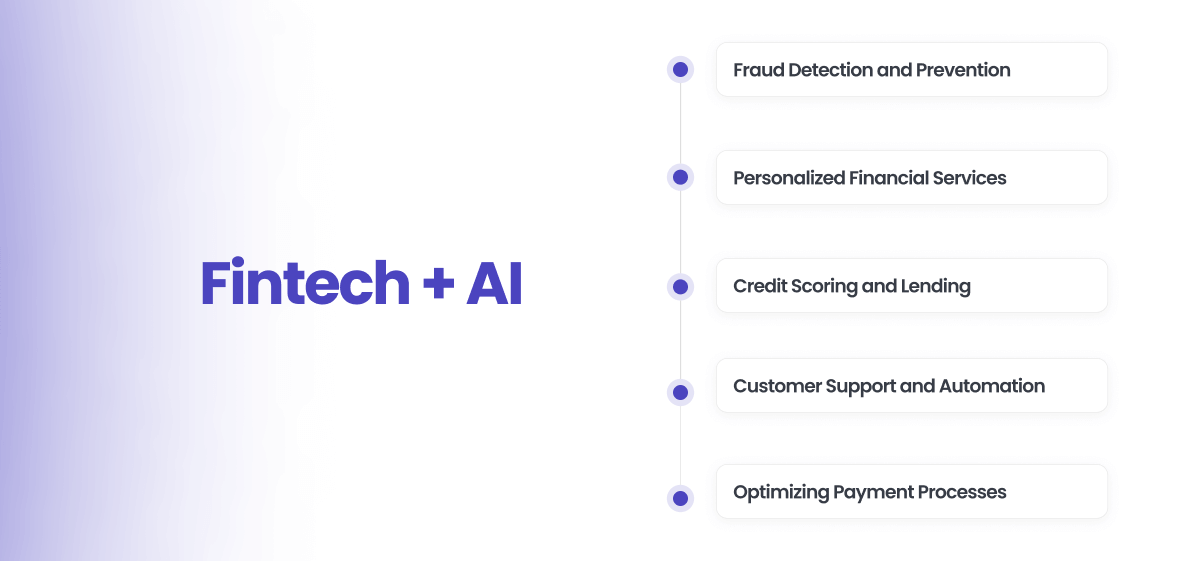
1. Fraud Detection and Prevention
One of the most prevalent use cases of AI in fintech is fraud detection. With the growth of digital transactions, the need for real-time fraud prevention has intensified. It’s like trying to catch a criminal before they even know they’re committing the crime.
Paypal: PayPal uses AI-powered fraud detection systems to analyze millions of transactions in real time. Their AI models can identify suspicious patterns, flag unusual transactions, and prevent fraud before it happens. Their deep learning models get better with every transaction, which means their fraud-fighting abilities keep leveling up.
Stripe Radar: Similarly, Stripe uses machine learning to stay ahead of evolving fraud tactics, collecting data from millions of businesses globally. In 2025 they rolled out a transformer-based Payments Foundation Model trained on tens of billions of transactions, and expanded Radar beyond cards to ACH and SEPA payments. Reported impact: a 38% average reduction in fraud, 42% on SEPA, 20% on ACH, and a 17% drop in dispute rates while global e-commerce fraud rose 15%.
2. Personalized Financial Services
Forget generic advice—AI is all about hyper-personalized financial recommendations these days. No more one-size-fits-all. It goes beyond basic recommendation engines and includes individualized financial advice, investment recommendations, and spending analysis.
Betterment: They are like having a financial advisor that never sleeps or takes vacations. In the investment sector, Betterment uses AI to provide automated portfolio management. Their AI system rebalances portfolios and maximizes tax efficiency automatically. It also helps in tax-loss harvesting, maximizing tax efficiency without human intervention.
Cleo: This is an example on the consumer side—an AI-driven financial assistant Cleo uses natural language processing (NLP) to help users track their spending, save money, and stay on top of their financial goals. It not only helps you budget but will also tell you when you’re being too reckless with your spending. It’s tough love, but sometimes we need it, right?
Revolut: They are turning their app into an AI-powered personal finance assistant that not only advises but executes. It handles transfers, FX and savings actions on behalf of the user. And after acquiring Berlin-based startup Swiftly in 2025, it can even complete travel bookings autonomously in under two minutes. It’s a glimpse at what "agentic" consumer fintech looks like.
Nubank: Now past 127 million customers across Brazil, Mexico and Colombia, they’re embedding generative AI across customer support, credit decisioning and personalized offers. Their LLM-powered assistants handle first-line support in Portuguese, Spanish and English, while internal AI models tailor credit limits and product recommendations at a scale traditional banks can’t match.
3. Credit Scoring and Lending
Traditional credit scoring models have often been criticized for their lack of inclusivity. AI is rewriting the rules by using more diverse data points, providing financial access to underbanked populations.
Zest AI: They are bringing a fresh perspective to credit scoring by going beyond traditional FICO scores. Instead of relying on narrow data sets, they use thousands of data points to assess creditworthiness, offering more inclusive lending opportunities. Major players like Freddie Mac and Citi are already tapping into it to approve loans for a broader audience.
Upstart: Upstart takes it a step further by evaluating factors like education and job history to approve loans. They claim its AI-driven approach has allowed them to approve 27% more borrowers while cutting down losses by 75%. It’s like getting a second chance when the system would otherwise say "no thanks."
4. Customer Support and Automation
Anyone else slightly terrified when customer support AI gets too good?
Chatbots and AI-driven virtual assistants are widely used to enhance customer service in fintech. They help companies scale customer interactions, reduce response times, and provide accurate information without human intervention.
Klarna: Take Klarna. Their OpenAI-powered assistant handles roughly two-thirds of all customer chats in 35+ languages—about 1.3M conversations a month. After an aggressive AI-only phase in 2024, Klarna returned to a hybrid AI + human model in 2025, making it a textbook case of where AI customer support works, and where it doesn’t.
Kabbage:They say time is money, and Kabbage is clearly in the business ofsaving both. Instead of relying on manual checks, their AI systems review and approve loan applications based on real-time financial data from bank accounts, reducing approval times from weeks to just minutes.
5. Optimizing Payment Processes
AI it’s also about making payments faster and smoother—because no one likes a declined transaction at checkout. Payment companies are leveraging AI to optimize and secure the payment experience, not just for fraud detection, but also for improving the entire transaction lifecycle.
Visa: In 2025 Visa launched Visa Intelligent Commerce, a framework that lets AI agents initiate and authorize payments on behalf of consumers. So an AI shopping assistant can actually complete a purchase, not just recommend one. It’s Visa’s bet on the coming wave of "agentic commerce," which FintechWeekly estimates could drive over US$262 billion in sales.
Mastercard: They use AI in its decision intelligence technology to reduce false declines while improving security. ThisAI model analyzes billions of data points to determine the likelihood of a transaction being fraudulent. It’s like they’ve got eyes everywhere, ensuring more legitimate payments go through without a hitch. They recently rolled out Agent Pay in parallel, enabling verified AI agents to transact on the Mastercard network with built-in identity, consent and fraud controls. Between Visa and Mastercard, the rails for AI-driven payments are officially open for business in 2026.
Adyen: Over at Adyen, AI is optimizing payment routing. By using machine learning, their AI automatically chooses the most efficient and cost-effective route for transactions, reducing payment failures and maximizing conversion rates for merchants. It’s like GPS for your money—always finding the best route.
6. Risk Management and Compliance
AI in risk management sounds like the least fun party trick, but it’s a game-changer in Fintech. It’s proving to be an invaluable asset for managing risk and ensuring compliance.
HSBC: HSBC uses AI to improve its anti-money laundering (AML) systems. By deploying AI models that monitor transaction activity, they can identify potential cases of money laundering faster and with more accuracy than traditional methods. Their AI models scan transactions faster than a human could ever dream of, catching suspicious activity before it escalates. (It’s not glamorous work, but it sure is important.)
ING: ING uses AI to predict market risks, making sure they’re always one step ahead. Their AI systems analyze vast amounts of financial data to provide predictive insights into potential market risks, helping them mitigate exposure and optimize investment strategies.
Feedzai: Feedzai uses AI to unify fraud detection and anti-money-laundering monitoring into a single platform—historically these were separate systems that didn’t talk to each other. Their machine-learning models score every transaction for both fraud and AML risk simultaneously, and in 2025 Novobanco picked Feedzai specifically to replace its fragmented compliance stack with one unified AI-driven system.
ComplyAdvantage: ComplyAdvantage takes an API-first approach to AML, making it a favorite of digital banks and fintechs. Their Mesh platform uses large language models to screen for up to 49 sub-categories of risk, and its agentic-AI case remediation works 24/7 to auto-clear low-risk alerts while escalating the complex ones to human analysts. Less alert fatigue, faster onboarding.
Key takeaways: AI’s tangible impact on Fintech
"The market size of artificial intelligence (AI) in fintech was 42.83 billion U.S. dollars in 2023, which grew to 44.08 billion U.S. dollars in 2024. Driven by a projected compound annual growth rate (CAGR) of 19.7 percent from 2025 to 2030, the market is expected to surpass 100 billion U.S. dollars by 2030."
So, what’s the big picture here? AI isn’t just about flashy algorithms or futuristic buzzwords. It’s about results. Whether it’s keeping your transactions secure, offering personalized services, or optimizing payments, these Fintech and Payment companies are leading the charge, showing us what’s possible when AI is used thoughtfully.
Truth is the companies using AI today are setting the standard for the future of finance. By curating the right tools and technologies, Fintechs and Payment companies are positioning themselves to lead in a rapidly evolving market.
As you can see, there’s no filler here—just real companies doing real things with AI. Which is what we came for. The future of fintech and payments is being built today, one AI-driven innovation at a time—and those who adapt will lead the way.