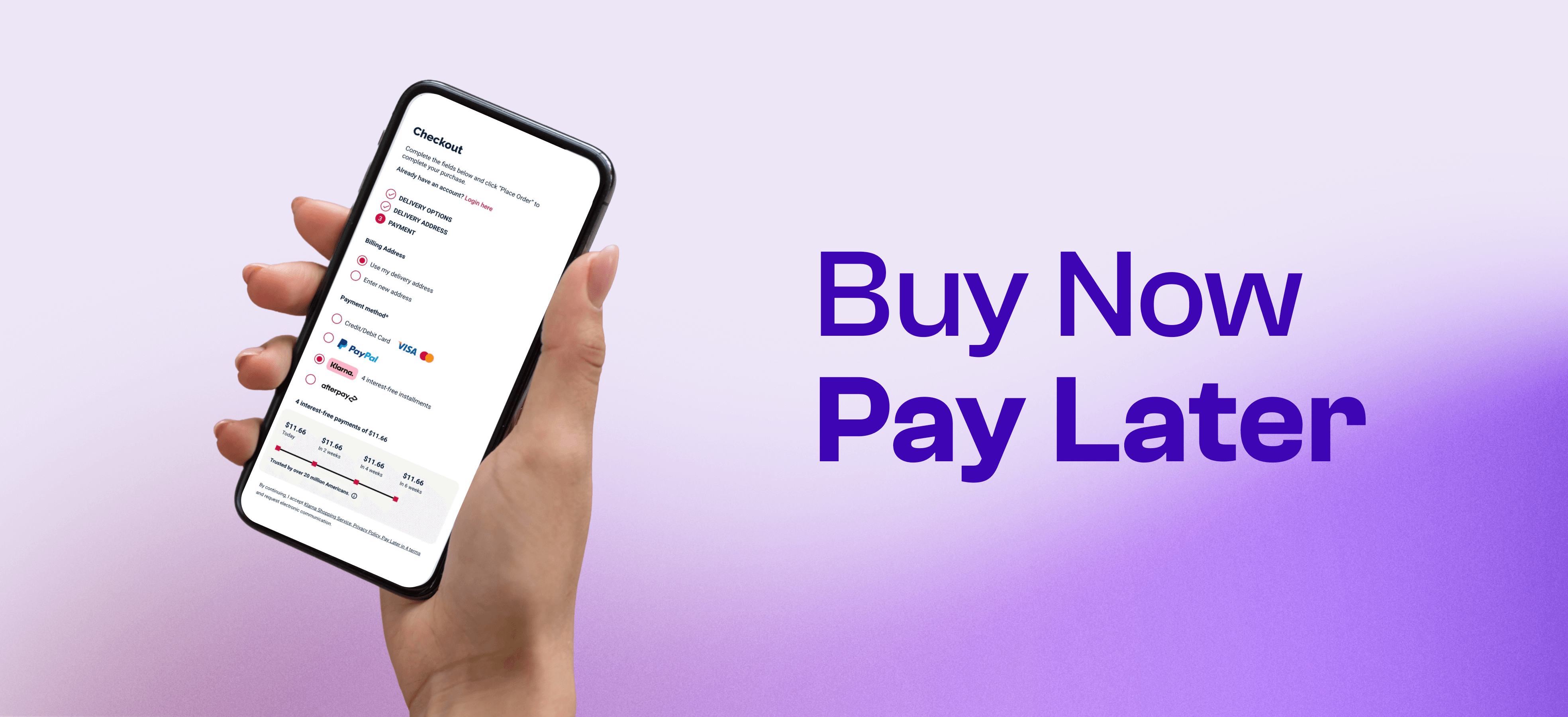
If you've made an online payment in 2025, or even earlier, you've probably noticed that checkout pages now show more payment options than ever. Alongside cards and digital wallets, it's increasingly common to see Buy Now, Pay Later logos such as Klarna, Afterpay, Zip, or Affirm.
While these options are becoming more familiar, BNPL can still feel confusing or hard to distinguish from a traditional credit card. In this blog, we'll break down the main concepts behind Buy Now, Pay Later in a clear and simple way, explaining how it works and what makes it different from other payment methods.
What is BNPL (Buy Now Pay Later)?
Buy Now, Pay Later (BNPL) is a digital payment method that lets consumers purchase immediately and pay over time in installments, often interest-free. It works as a short-term loan for the consumer, where merchants receive the full payment upfront, while a BNPL provider handles credit approval, risk management and installment collection.
How does Buy Now, Pay Later work?
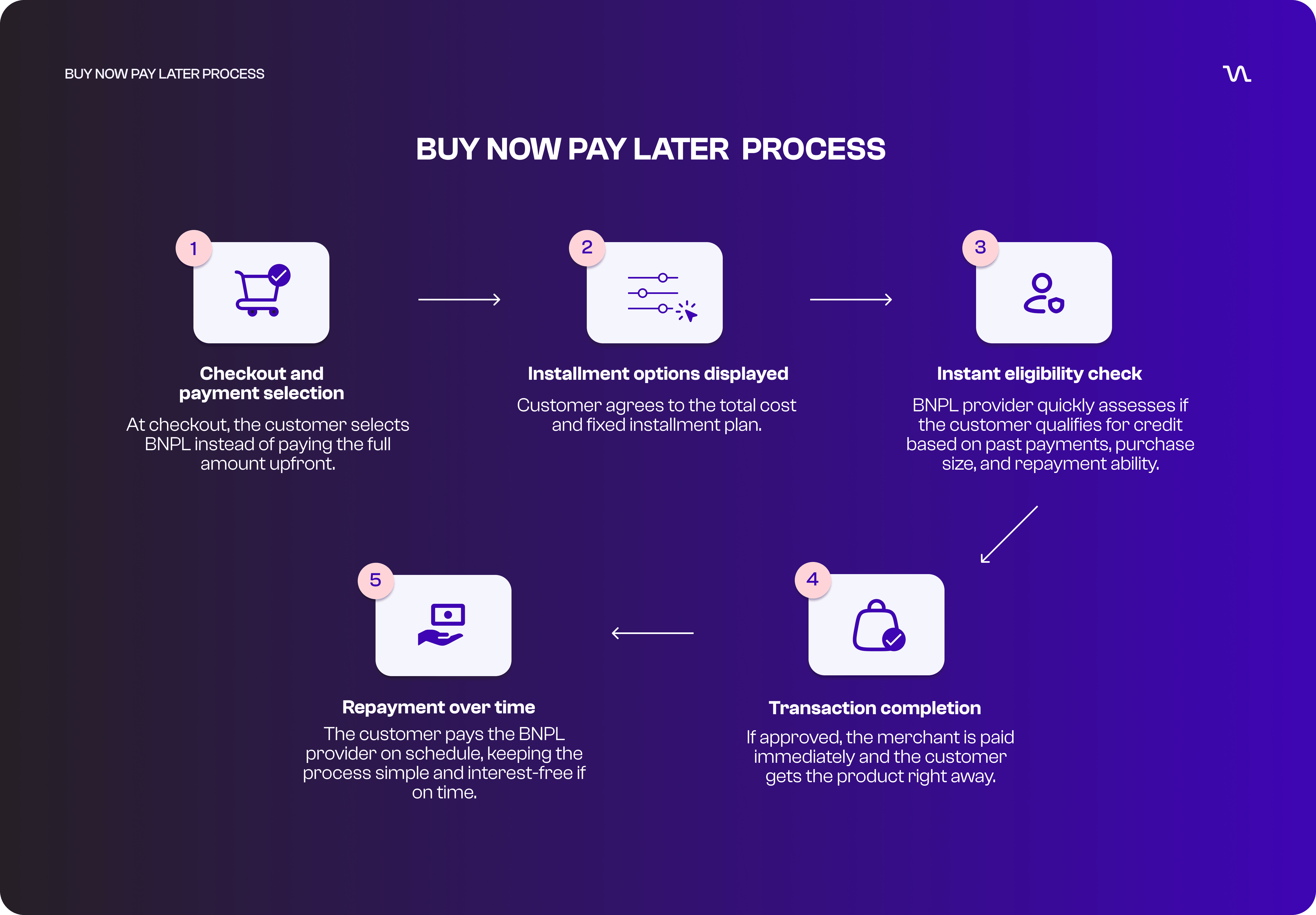
Buy Now, Pay Later is designed to be simple and frictionless for both consumers and merchants. Below is an overview of the step-by-step of how Buy Now, Pay Later works:
1. Checkout and payment selectionThe customer reaches checkout and chooses BNPL as the payment method instead of paying the full amount upfront.
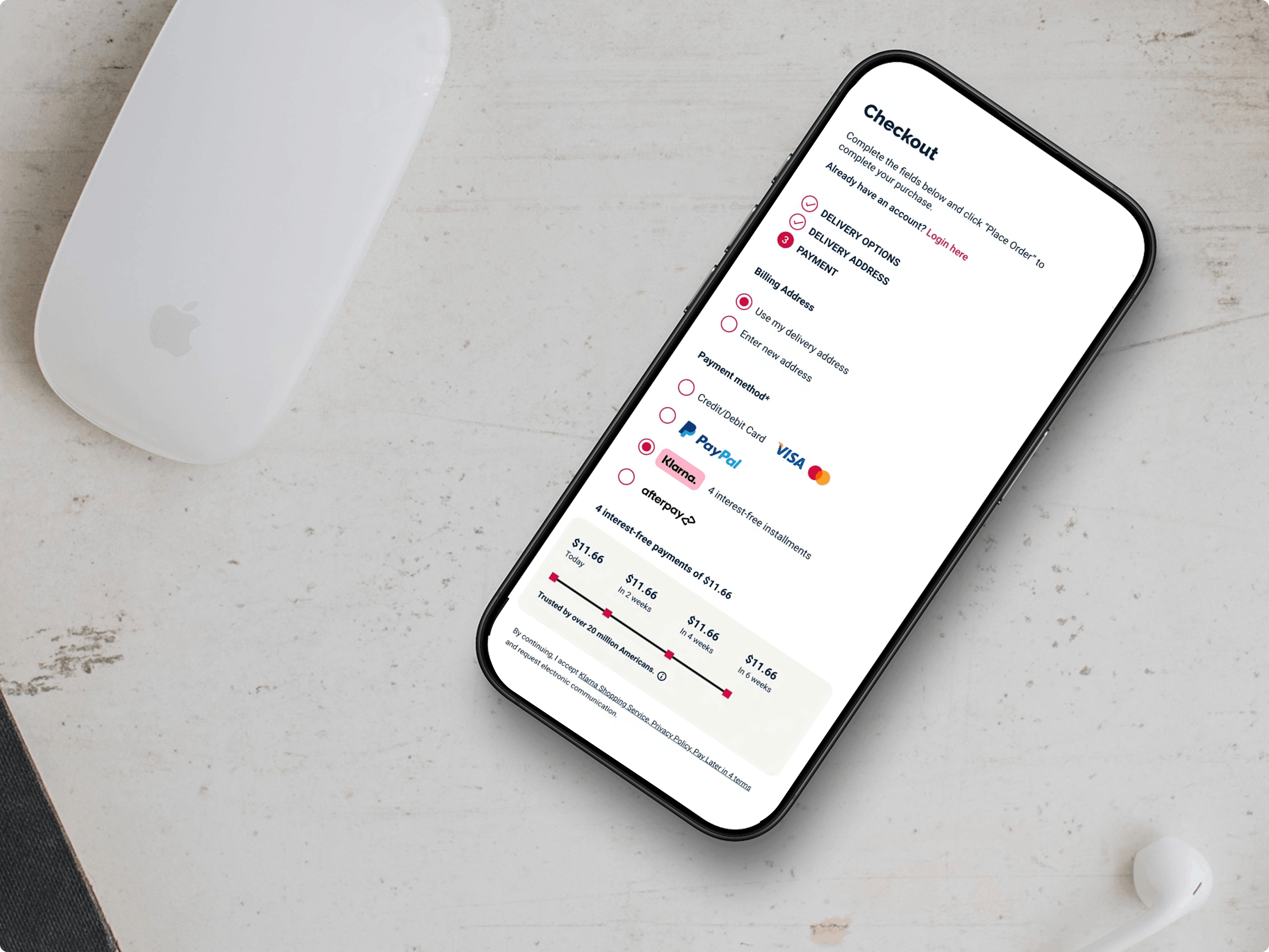
2. Installment options displayedOnce BNPL is selected, the customer is presented with a clear repayment plan according to the BNPL provider of their choice, typically split into fixed installments. The total cost and payment schedule are shown upfront, improving transparency and predictability.
3. Instant eligibility checkThe BNPL provider performs a real-time assessment to determine whether the customer qualifies for the payment plan. This process usually takes only seconds and often does not involve a traditional hard credit check. While criteria vary by provider, this assessment usually looks at the customer's past payments, estimated ability to repay, and the size of the purchase.
4. Transaction completionIf approved, the purchase is completed immediately. The merchant receives payment upfront from the BNPL provider and the customer gains access to the product or service without delay.
5. Repayment over timeThe customer repays the amount according to the agreed schedule, making payments directly to the BNPL provider. As long as payments are made on time, the experience remains interest-free and straightforward.
BNPL vs. Traditional credit methods
Unlike traditional credit cards or consumer loans, Buy Now, Pay Later (BNPL) is embedded directly into the checkout experience. Instead of applying for credit in advance, consumers can select BNPL at the moment of purchase and receive instant approval, with payments split into fixed installments that are often interest-free. Merchants, meanwhile, receive the full payment upfront.
Traditional credit methods rely on revolving credit lines, interest accumulation, and prior approval processes. BNPL reframes credit as a pay-as-you-go experience, which has proven especially appealing to younger, digital-first consumers and has helped merchants reduce friction and improve conversion at checkout.
Below, we break down some of the key differences between BNPL and traditional credit methods and common questions that arise when trying to understand Buy Now, Pay Later:
How does credit limit work with BNPL?
BNPL does not usually offer a single, fixed credit line like a traditional credit card. Instead, most providers use flexible limits that depend on each purchase. Approving or declining each transaction individually based on factors such as purchase amount, user behavior and real-time risk assessments. Some BNPL providers also introduce account-level limits that evolve over time as users build repayment history.
This model can give consumers more flexibility and access to credit, especially those with limited or troubled credit histories, but it also introduces less predictability than traditional credit cards, which operate with clear, pre-approved limits that define purchasing power upfront. However, BNPL companies restrict the use of their service if the user misses a payment, controlling overspending and accumulating debt.
Do BNPL services have any monthly costs and fees?
Most Buy Now, Pay Later plans do not charge a monthly fee simply for using the service. Short-term installment plans are typically interest-free, with pricing and repayment schedules clearly disclosed at checkout. Costs usually arise in specific cases, such as late or missed payments.
Traditional credit cards, on the other hand, often include monthly or annual fees, variable interest rates and compounding charges when balances are carried over, making the total cost of credit harder for consumers to anticipate over time.
Can I make cross-border and international purchases with BNPL?
BNPL availability for international purchases depends on the provider and merchant integration, but many global platforms now support cross-border BNPL at checkout, especially within large payment ecosystems. This has expanded BNPL usage beyond domestic e-commerce into global retail and digital services.
Credit cards remain more universally accepted for international spending, but they often come with foreign transaction fees and currency conversion costs, which BNPL solutions may avoid depending on the provider and region.
How do BNPL companies make money?
Buy Now, Pay Later providers primarily make money through merchant fees, not consumer interest. For each BNPL transaction, merchants pay a fee in exchange for higher conversion rates, larger average order values, and reduced cart abandonment. In short, merchants often prefer a sale with a "discount" over no sale at all.
Some providers also generate revenue from late fees or interest on longer-term installment plans, though many short-term BNPL options remain interest-free.
Companies leading BNPL adoption
Buy Now, Pay Later first appeared in the early 2000s through early digital credit products, and later evolved into a widely adopted payment model driven by players like Klarna, Affirm and Afterpay, which introduced installment-based payments as a checkout option.
Today, major payment platforms including PayPal, Apple Pay, and Stripe have incorporated BNPL into their payment ecosystems, positioning it as a mainstream solution within modern digital payments.

PayPal has integrated Pay in 4 directly into its global checkout experience, accelerating BNPL adoption by leveraging its existing merchant and consumer base. Stripe added Klarna to its payments stack, allowing merchants across several regions to support Buy Now, Pay Later installments directly within the checkout flow.
In Latin America, major payment platforms are incorporating BNPL into their broader payment offerings. Mercado Pago has embedded installment-based payments directly into its digital wallet and merchant checkout flows, while Nubank provides installment options and flexible credit features within its super-app experience.
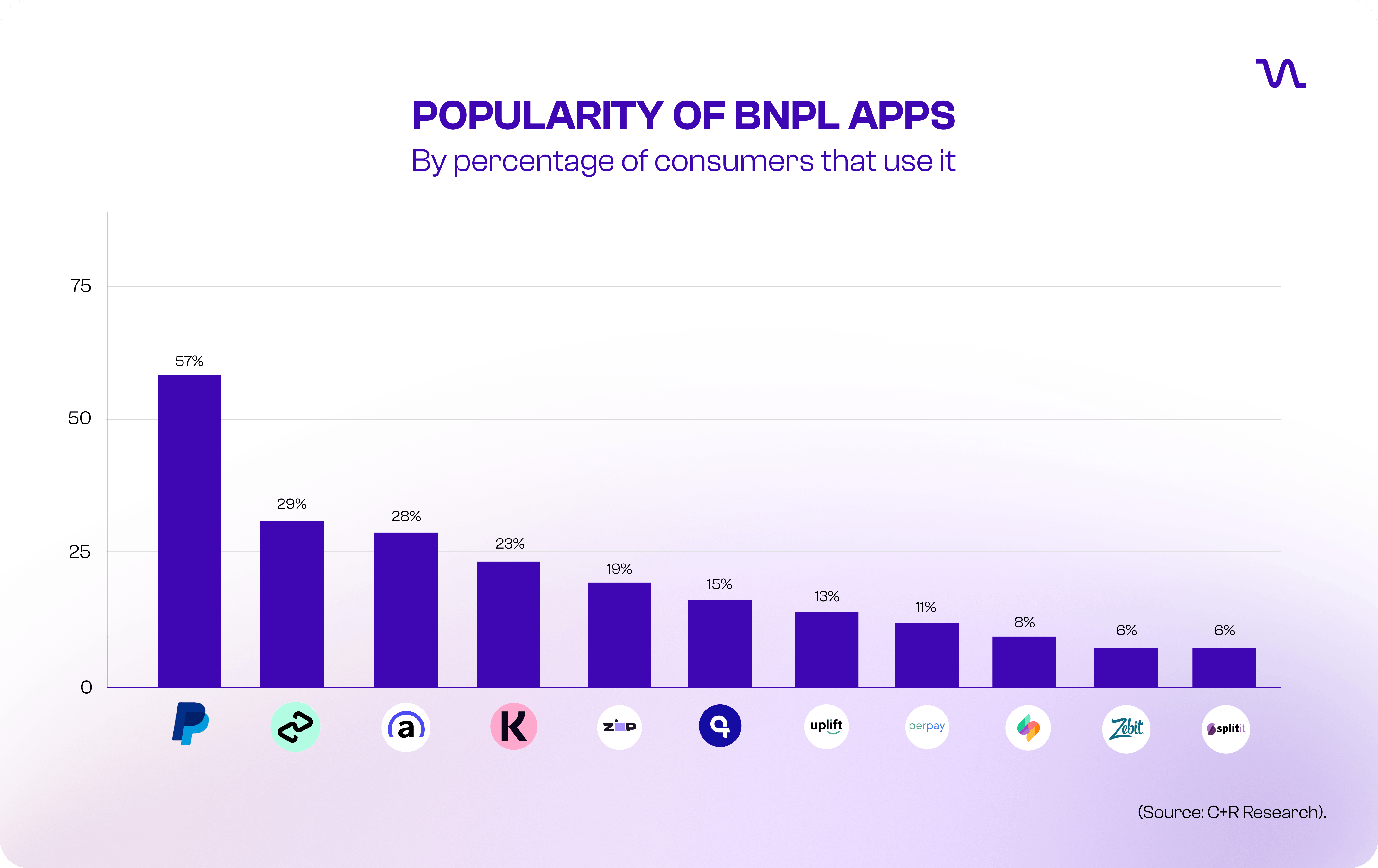
According to Demand Sage (2025), PayPal Credit leads BNPL adoption, with 57% of consumers reporting usage. It is followed by Afterpay and Affirm at 29% and 28%, respectively, while Klarna ranks next with 23%, and Zip with 19%.
How BNPL is growing and who's using it / Who uses BNPL?
Buy Now, Pay Later (BNPL) is growing rapidly as consumers seek flexible, short-term payment options that reduce reliance on traditional credit cards. According to the Worldpay Global Payments Report, BNPL is one of the fastest-growing payment methods worldwide, driven by the popularity of installment-based payments at checkout.
Adoption is especially strong among younger, digital-first consumers, who use BNPL at significantly higher rates than older demographics. Millennials and Gen Z make up the largest share of BNPL users, accounting for approximately 67% of transactions, with particularly strong adoption in categories such as fashion, electronics, and beauty.
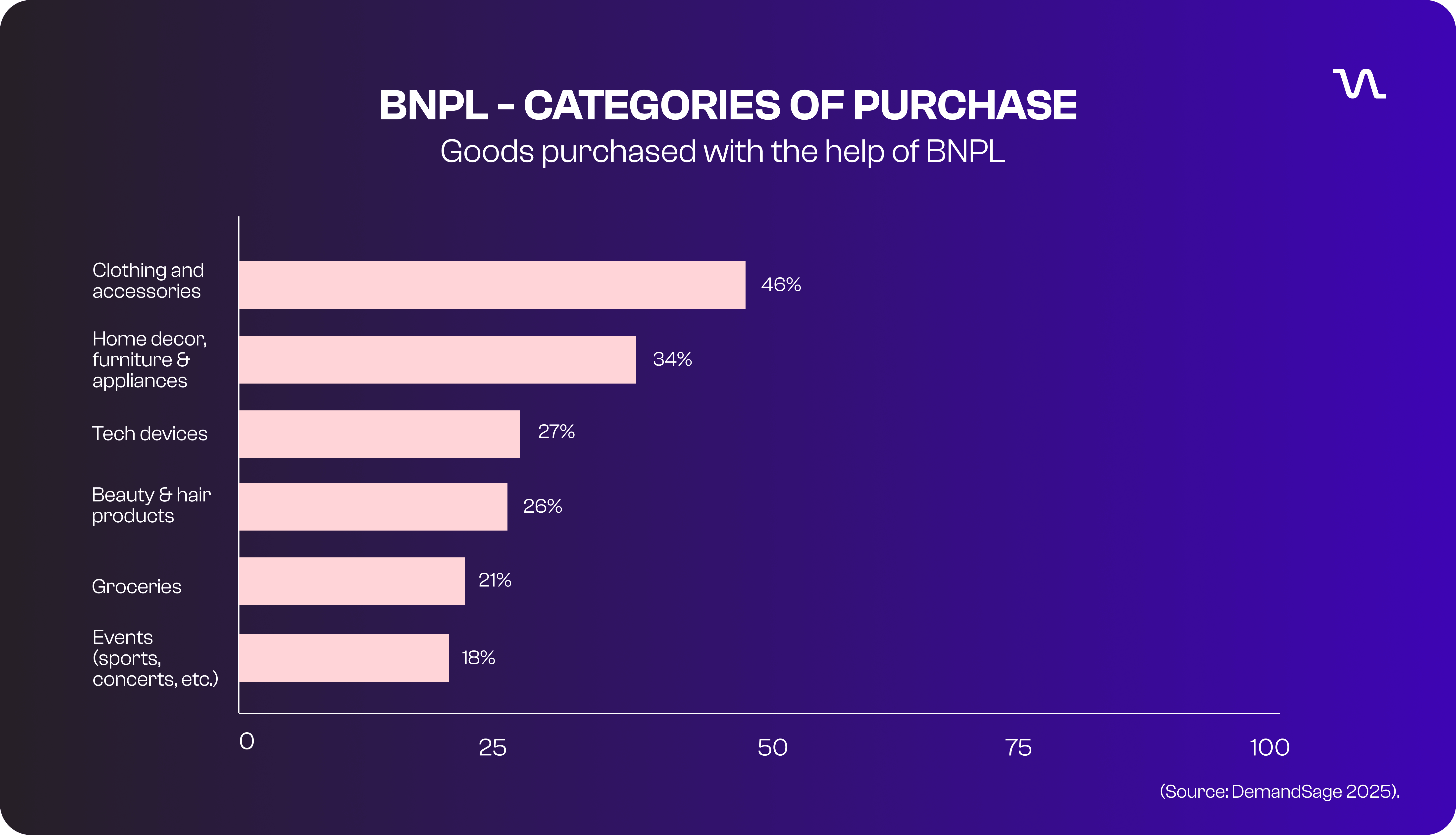
At the same time, merchants are adopting BNPL to reduce checkout friction and increase revenue. Stripe's A/B testing shows that offering Buy Now, Pay Later at checkout can increase revenue by up to 14%, driven by higher conversion rates and larger average order values.
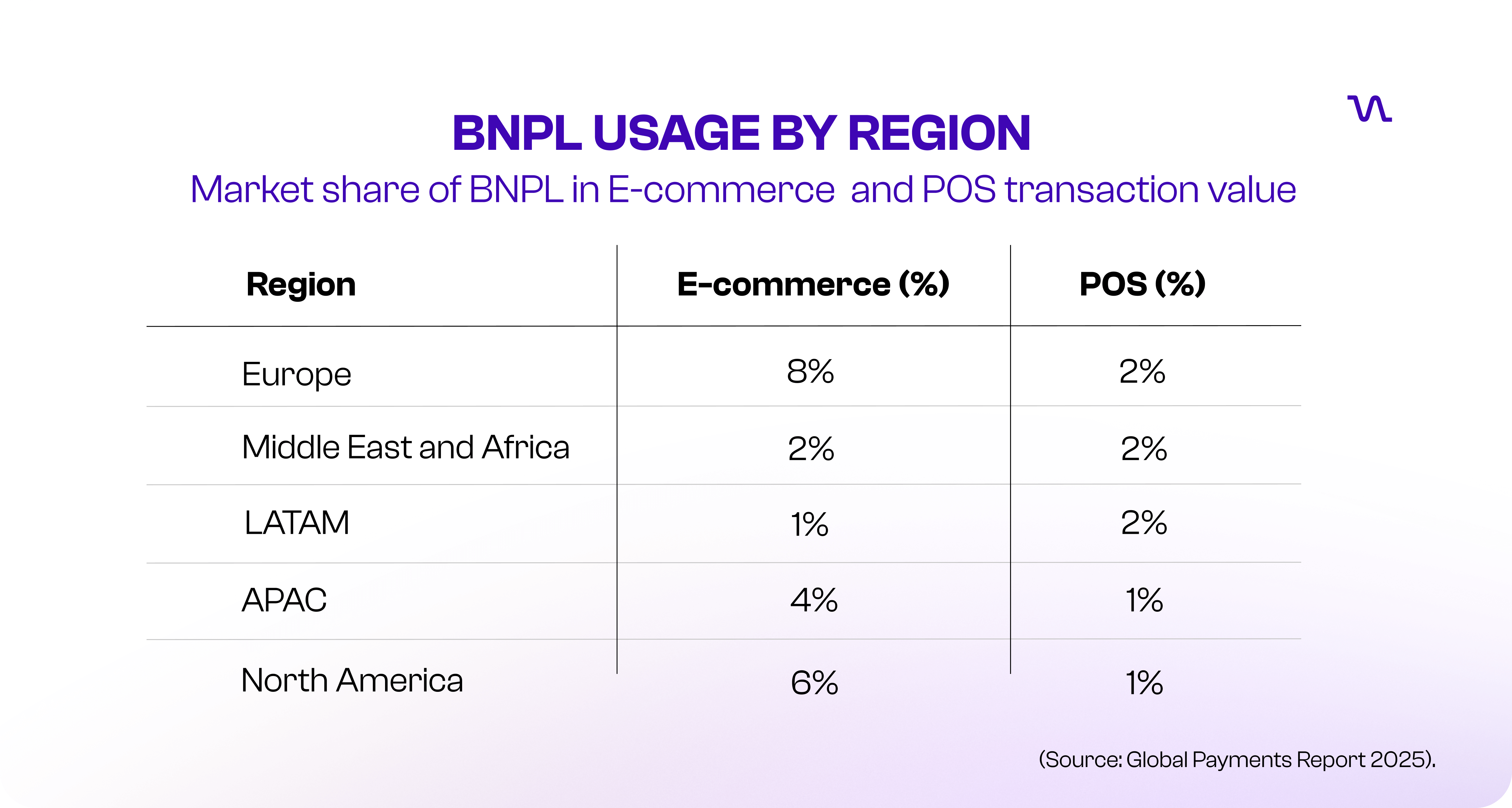
According to Worldpay's Global Payments Report 2025, Buy Now, Pay Later already accounted for about 5% of total global e-commerce value in 2024 (roughly US $342 billion) and is expected to grow steadily through 2030, highlighting how embedded this payment method has become in online commerce.
BNPL adoption varies widely by region. While it remains less established globally than cards and digital wallets, usage is clearly growing, reaching around 10% of e-commerce transactions in Europe and about 5% in the US and Asia-Pacific (APAC). Latin America (LATAM) shows the lowest adoption, with BNPL gaining more traction in regions with higher e-commerce penetration, weaker banking systems, and higher inflation (DemandSage 2025).
Benefits of BNPL for consumers
For consumers, BNPL offers greater flexibility and control at checkout. It allows shoppers to split purchases into manageable installments, avoid revolving credit card debt and better align payments with their cash flow. This is especially valuable for higher-value purchases or for digital-first users who prefer transparent, short-term payment options.
Benefits of BNPL for merchants
For merchants, BNPL functions as a growth and conversion lever rather than a financing burden. By offering installment payments directly at checkout, businesses can reduce friction, increase conversion rates and encourage larger basket sizes. Importantly, merchants get paid upfront while the BNPL provider assumes the credit and repayment risk.
As a result, Buy Now, Pay Later helps merchants improve performance at the point of sale while delivering a smoother payment experience for customers.
Conclusion
Beyond a simple payment method, BNPL highlights a broader shift in consumer behavior. Its rise reflects how younger, digital generations approach spending, favoring flexibility, transparency and short-term commitments over traditional credit models.