All Post
Beyond the whiteboard: The algorithms behind Fintech & Payments
Every computer science student grinding through LeetCode at 1 AM has wondered: “Do we actually use this stuff on the job?”
As a software engineer specialized in Fintech and payments, I can tell you the answer is a resounding yes.
In Fintech, these algorithms aren’t just abstract interview hurdles. They are the engines that stop fraud, move money around the globe, and prevent catastrophic (and expensive) errors. They are the difference between a system that handles 100 transactions a second and one that handles 100,000.
Let’s pull back the curtain and look at a few of the most common “interview” data structures and where you’re already using them (or will be) in the real world of finance.
1. Hash Maps (The O(1) lifesaver)
The "LeetCode" Problem: “Two Sum,” “Contains Duplicate,” “Logger Rate Limiter.”
The Core Concept: Insanely fast O(1) — or constant time — lookups, inserts, and deletes.
The Fintech Application: Distributed Transaction Deduplication
This is the most critical O(1) operation in payments. Picture this: a customer clicks “Pay”, but their connection lags and the request times out. What do they do? They click “Pay” again.
The problem: In a distributed system with dozens of servers, how do you ensure the customer isn’t charged twice?
The solution: Use a Distributed Cache like Redis (which is conceptually a massive, persistent Hash Map shared across all your servers).
The client (mobile app or frontend) generates a unique idempotency-key (like a UUID) and sends it in the request header.
When the request hits your server, you check your Redis cache: redis.exists(key).
If the key exists, you return the previous result immediately O(1).
If not, you process the payment and store the result mapped to that key.
By relying on the O(1) lookup speed of a hash map structure, you can handle thousands of concurrent requests while guaranteeing that no matter how many times a button is clicked, the money only moves once.
The Fintech Application: Caching Card Metadata (BIN Lookups)
Every time a user types in their card number, your system needs to answer questions instantly to calculate fees and routing: “Is this a Visa or Mastercard?”, “Is it Credit or Debit?”, “Is it a US card or European?”
This data is derived from the BIN (Bank Identification Number) - the first 6-8 digits). This data rarely changes, but it is read millions of times a day.
The Solution: Instead of querying a slow SQL database for every single swipe, you load this metadata into an in-memory Hash Map.
A lookup for bin_metadata['424242'] returns the card details in nanoseconds. This reduces database load by 99% and shaves critical milliseconds off the checkout experience.
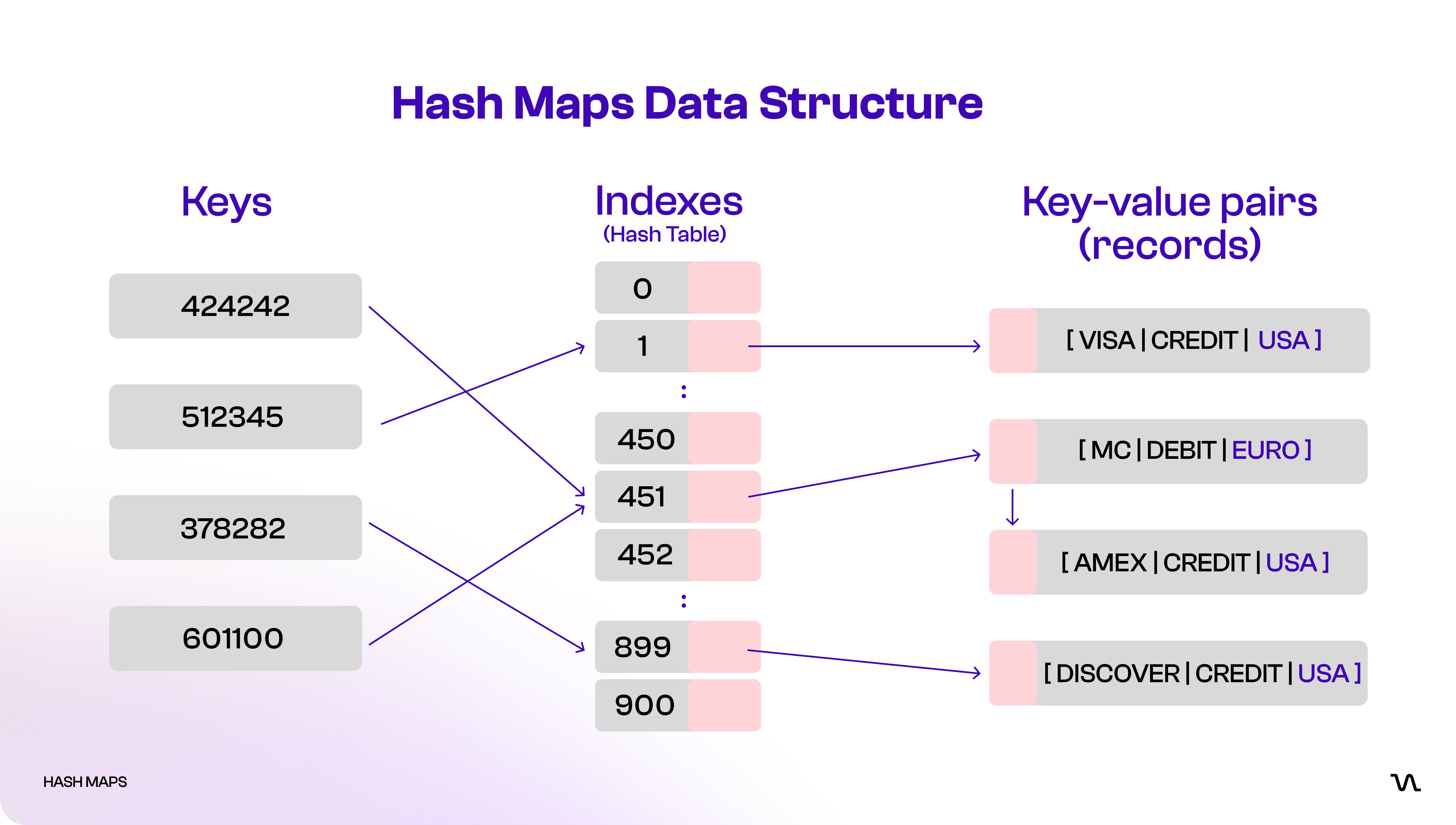
Hash Maps Data Structure
2. Graphs (The fraud & network detectives)
The "LeetCode" Problem: “Number of Islands,” “Word Ladder” (BFS), “Shortest Path in Graph” (Dijkstra’s).
The Core Concept: Modeling and analyzing complex relationships between entities.
The Fintech Application: Feeding the AI Models (Fraud Detection)
Graph algorithms are one of the most powerful tools in modern fraud detection, AML monitoring, and risk intelligence. A fraudster never works with just one account.
The problem: You flag Account X for suspicious activity. How do you identify its co-conspirators or uncover a potential money-laundering ring?
Modern fraud detection relies heavily on Artificial Intelligence, but AI is only as good as the data you feed it. Raw transaction rows aren’t enough; the AI needs context.
The Solution: Graph algorithms perform the heavy lifting of “feature engineering” for the AI.
Before the AI makes a decision, a graph traversal runs in the background. It answers questions like: “Is this new account connected to any device ID previously used by a known fraudster?” (Connected Components).
The Graph Algorithm calculates a “risk score” based on these connections, and passes that score to the AI model. The Graph finds the hidden network; the AI pulls the trigger.
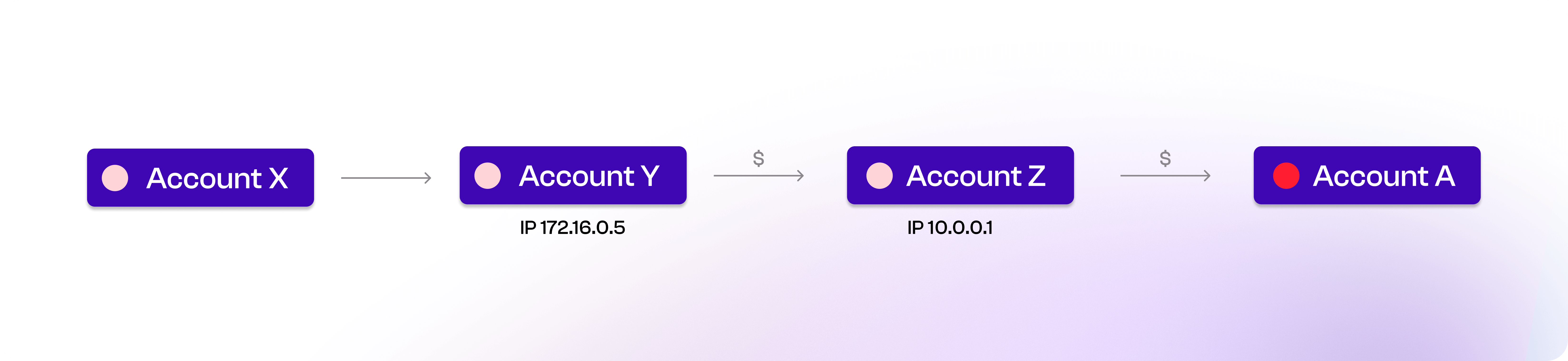
Fraud Detection using Graphs
You’ve just exposed a multi-account fraud cluster or a sophisticated money laundering ring using graph modeling, which would be completely invisible when looking at isolated rows in a database table.
The Fintech Application: Smart Payment Routing
International payments don’t travel in a straight line from bank to bank. A transfer often moves through several intermediary (correspondent) banks before reaching its destination.
Nodes: Banks
Edges: A potential “hop” between two banks
Edge Weight: The cost (wire fee + FX fee) and time (settlement lag) for that hop.
The problem: What is the cheapest or fastest path for a payment to travel from Bank A to Bank B?
The solution: Use Dijkstra’s Algorithm on a weighted graph representing the global banking network. Your payment engine computes the optimal path in real time, reducing costs, lowering settlement delays, and improving success rates for cross-border transfers.
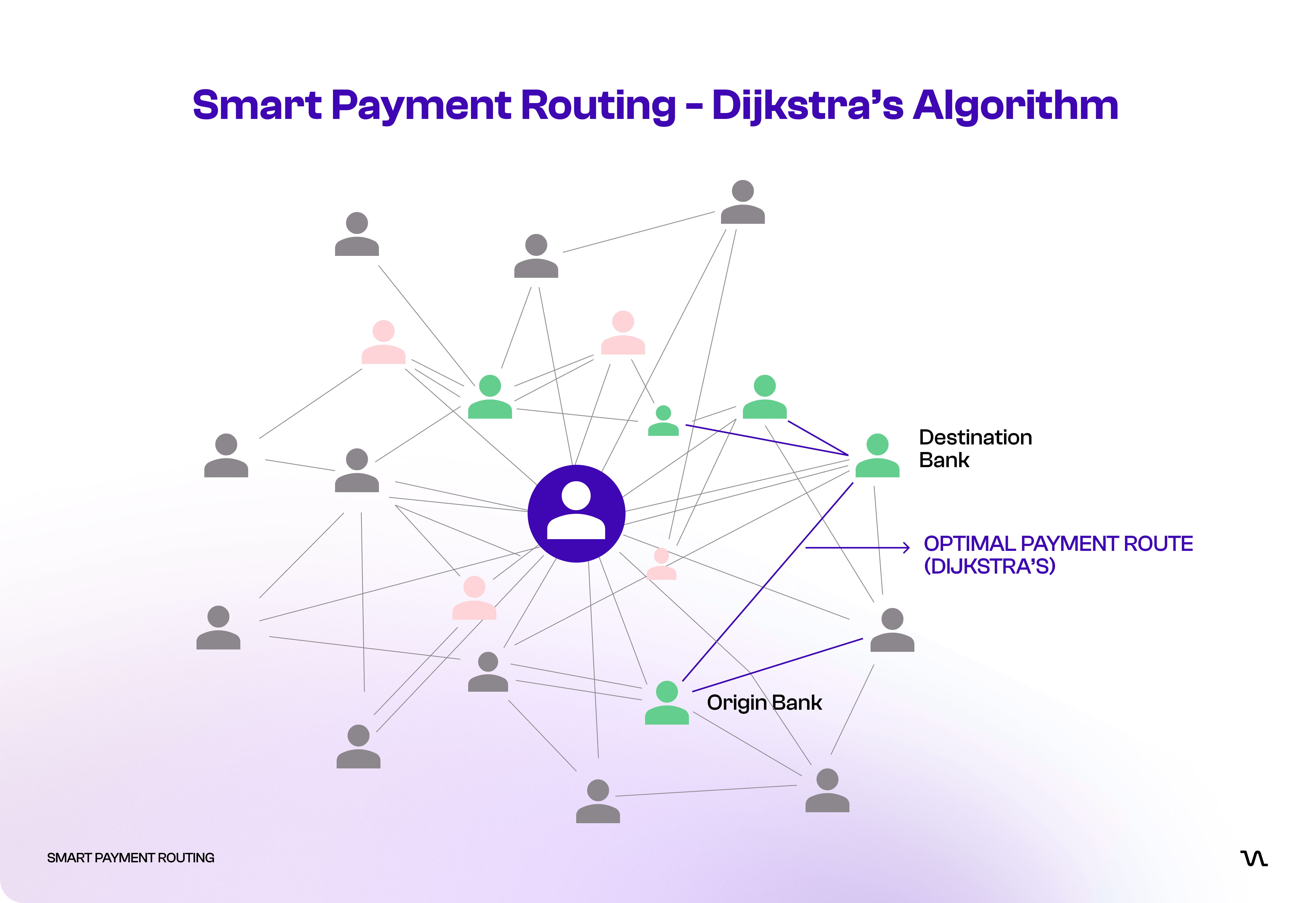
Smart Payment Routing - Dijkstra’s Algorithm
This is graph theory directly powering smarter, more efficient global payments.
3. Trees (The High-Speed Organizers)
The "LeetCode" Problem: “Implement Trie (Prefix Tree),” “Find Median from Data Stream” (Heaps), “Kth Smallest Element in a BST.”
The Core Concept: Storing and retrieving data in a sorted or hierarchical structure for fast O(log n) operations and prefix-based lookups.
The Fintech Application: Payment Prioritization (Task Scheduling)
A stock exchange’s matching engine has to match millions of buy and sell orders per second. Using lists or arrays would be far too slow, every lookup would take O(n) time.
The problem: How do you instantly find the highest bid and the lowest ask to determine if a trade can execute?
Imagine it’s Black Friday. Your payment system is getting hammered with 10,000 requests per second. Some are massive B2B wire transfers of $1,000,000 (critical VIPs), and others are $5 coffee purchases.
The Problem: If you process transactions in a simple First-In-First-Out (FIFO) queue, a critical high-value wire might get stuck behind thousands of small coffee transactions, causing delays for your most important clients.
The Solution: Use a Priority Queue (implemented as a Heap).
Instead of a simple list, incoming transactions are pushed into a Max-Heap based on their priority (e.g., transaction value or merchant tier).
Push: Adding a new transaction takes O(log n).
Pop: Your workers always pull the top element (O(log n)), which guarantees they are always working on the highest-value transaction currently in the system.
This ensures that even under heavy load, your system intelligently prioritizes the traffic that matters most.
The Fintech Application: Transaction Categorization (Tries)
When your banking app sees a messy transaction string like “STARBUCKS #12345 S SEATTLE WA”, how does it instantly classify it under “Coffee & Restaurants”?
The problem: You can’t use a hash map because the string is different every time.
The solution: Use a Trie (Prefix Tree).
You store all known merchant prefixes in the Trie:“STARBUCKS”, “AMZN Mktpl”, “UBER TRIP”, “SHELL OIL”...
When a new transaction string arrives, the app feeds it into the tree and finds the longest matching prefix in O(L) time (where L is the length of the string). That prefix identifies the merchant, which then maps to a spending category.
Tries power the fast, accurate merchant recognition and transaction classification behind modern banking apps.
Conclusion
So the next time you’re preventing duplicate payments, routing an international transfer, or uncovering a fraud network, remember this: you’re not just “doing your job”, you’re solving Contains Duplicate, Shortest Path, or Connected Components problems in the real world. And that's a good thing.
The interview grind was never just about memorizing LeetCode solutions. It was about training your mind to recognize patterns, and in Fintech, those patterns show up everywhere, powering systems that move millions of dollars every second.